
Signs and signals · 1/17
- Warning signs
- Give-way signs
- Prohibitory signs
- Mandatory signs
- Information and regulation signs
- One-way road
- Direction signs
- Hierarchy of rules
- Information signs
- Level crossing
- Road markings
- Signals from officers
- Traffic lights
- Additional panels
- Reading times on an additional panel
- Road works area
- Road works equipment
Warning signs
2 min read
A warning sign tells you about a danger and what kind it is. It sets no ban or speed limit, but you adjust your speed and attention to the danger in advance.
A warning sign () is a triangle with a red border and a yellow background. The symbol shows the type of danger. A round sign with a red border is a ban, and a blue square sign gives a regulation.
What does the sign require of you?
It does not create a ban or a speed limit by itself. But it makes the duty to adapt your speed to the conditions concrete: knowing about the danger and still not choosing your speed accordingly breaks this duty. Also, if there is a speed limit sign, it is binding. A recommended lower speed sign is only advice.
How far ahead is the danger?
The sign is placed at the distance where it is most effective by day and by night. This distance depends on the speed limit: closer to the danger inside a built-up area, further away outside it. If it is placed further away than usual, the distance is written on an additional panel.
If the additional panel gives no distance, you do not assume a single figure in metres. The warning is not void either. You start to prepare now.
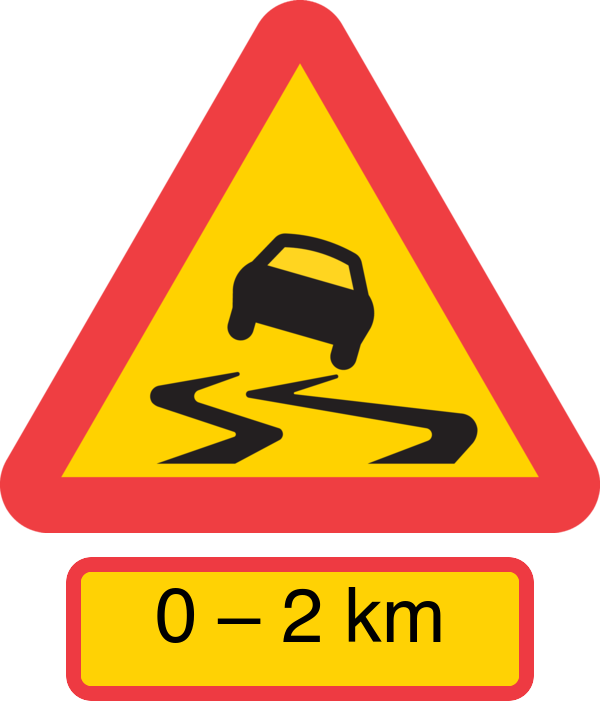
Read three signs correctly
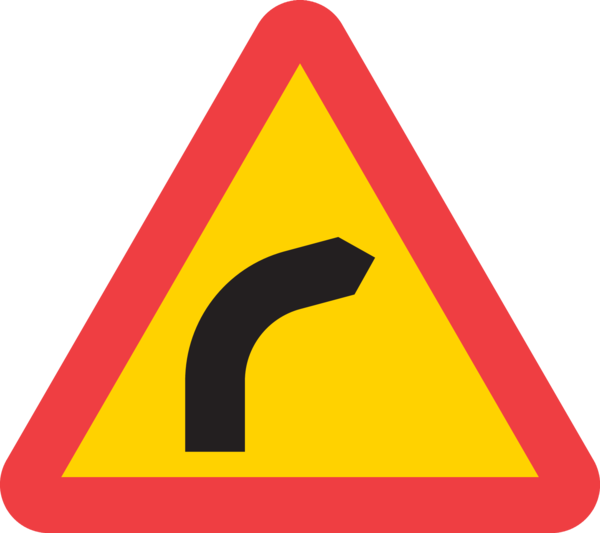
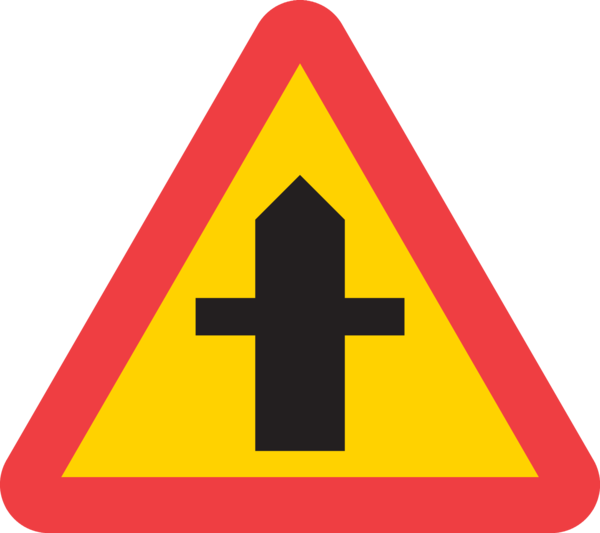
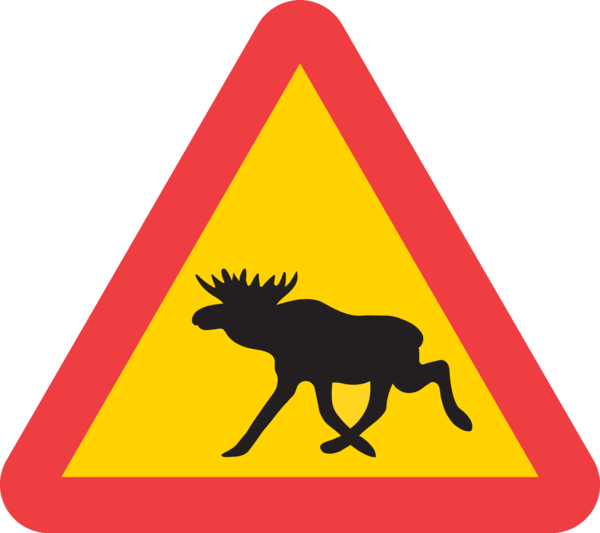
What the law says
Varningsmärken varnar för en fara och upplyser om farans art. Varningsmärken är uppsatta på det avstånd från faran som gör dem mest effektiva såväl på dagen som på natten.Unofficial translation: Warning signs warn of a danger and give information about the nature of the danger. Warning signs are placed at the distance from the danger that makes them most effective both by day and by night.
2 kap. 4 § vägmärkesförordningen
Try it yourself
2 questions from this lesson, no sign-in.
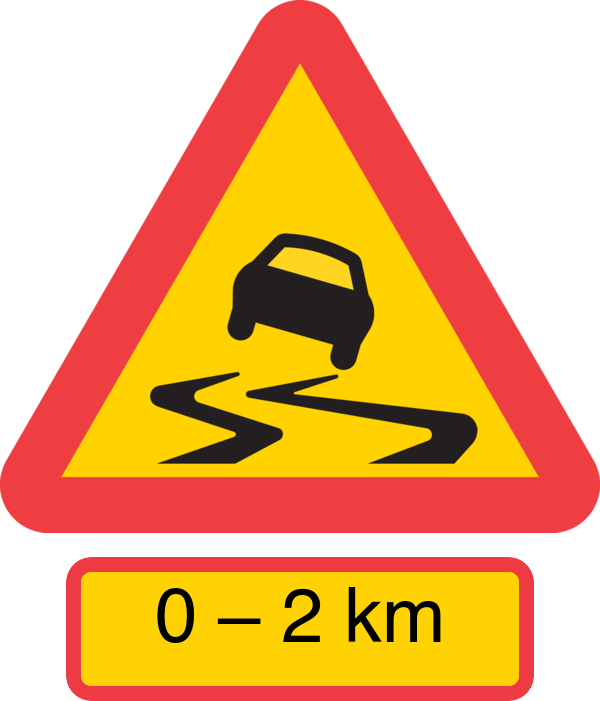
You pass the sign and panel in the image. For which stretch should you prepare for the slippery-road risk?
The start is 0; the stretch has not already ended.
2 km is not the remaining distance to the start.
A10 warns of a slippery road and T1 indicates the beginning and end of a stretch. The pictured 0–2 km means the stretch starts here and extends 2 km. This differs from T2’s distance to a hazard; adapt speed and following distance to conditions.
Does a warning sign introduce a rule?
The sign makes the obligation concrete; it is not without effect.
A warning sign does not on its own set a speed limit.
A warning sign indicates a hazard and its type; it does not on its own introduce a prohibition or a speed limit. But it makes the obligation to adapt your speed to the conditions concrete: failing to choose your speed accordingly when the hazard is known is a breach of this obligation. If there is also a speed limit sign, that is binding; a recommended lower speed sign, however, is only advisory.
More questions on this topic are in the app.