
Signs and signals · 2/17
- Warning signs
- Give-way signs
- Prohibitory signs
- Mandatory signs
- Information and regulation signs
- One-way road
- Direction signs
- Hierarchy of rules
- Information signs
- Level crossing
- Road markings
- Signals from officers
- Traffic lights
- Additional panels
- Reading times on an additional panel
- Road works area
- Road works equipment
Give-way signs
2 min read
B signs show who gives way: at a junction, at a pedestrian or cycle crossing and at a narrow section. They give no speed limit or mandatory direction.
| Sign | Shape or meaning |
|---|---|
| B1 give way | Inverted triangle |
| B2 stop | Octagon |
| B3 pedestrian crossing | Shows a pedestrian crossing |
| B4 priority road, B5 end of priority road | Yellow diamond |
| B6 give way to oncoming traffic | At a narrow section, you wait |
| B7 oncoming traffic gives way | At a narrow section, the other side waits |
| B8 cycle crossing | Shows a cycle crossing |
The speed limit is set by the C family of signs, and a mandatory direction by the D family.
What does a priority road give you?

Where there is no acceleration lane, a driver joining the priority road gives way to vehicles on it. Your priority comes from this. It does not remove the duty to adapt your speed to the conditions. It also does not remove the duty not to obstruct oncoming traffic when turning.
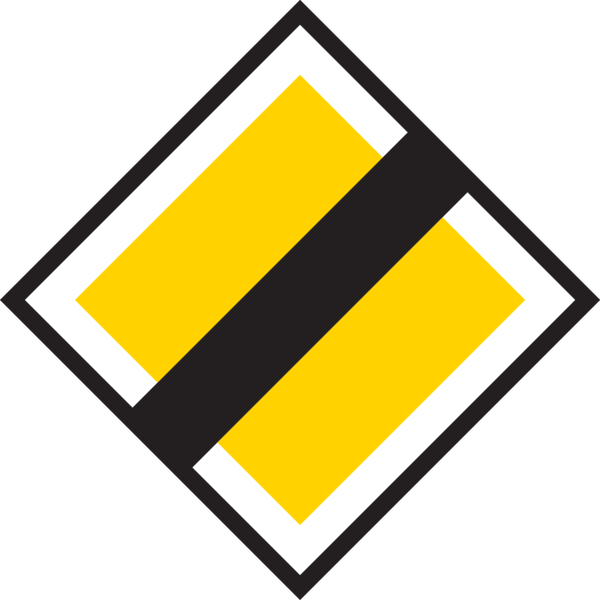
- After B5, at an ordinary junction with no other regulation, you give way to traffic from the right.
- A parking ban tied to the priority road ends. Only that ban ends: you also check the closeness to a junction, other signs and the general stopping and parking rules.
Arrows at a narrow section
The red arrow always shows the side that gives way. The arrow pointing up is your direction, and the arrow pointing down is the oncoming traffic.
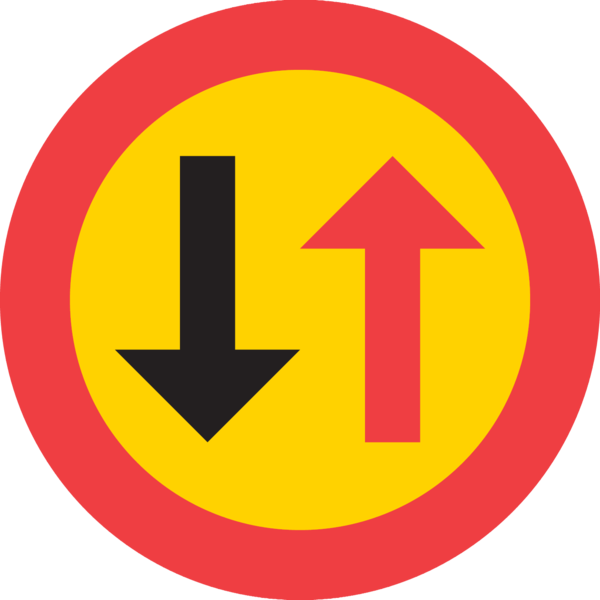
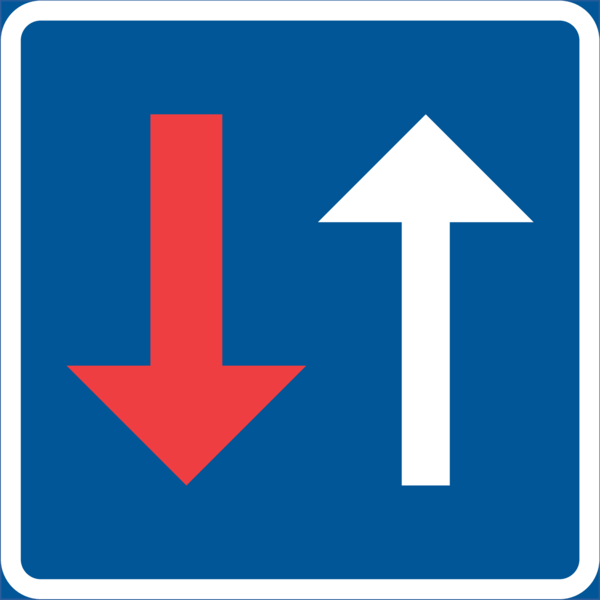
At B7, if the oncoming vehicle has entered the narrow section and you do not both fit, you wait. The other side's duty to give way does not give you the right to put yourself in danger or to make them reverse. A signal and a low speed do not change the lack of width.
What the law says
Märket anger att det är förbjudet att passera en sträcka om detta inte kan ske utan att mötande fordon hindras.Unofficial translation: The sign (B6) indicates that it is forbidden to pass a stretch if this cannot be done without obstructing oncoming vehicles.
2 kap. 6 § vägmärkesförordningen
Try it yourself
2 questions from this lesson, no sign-in.
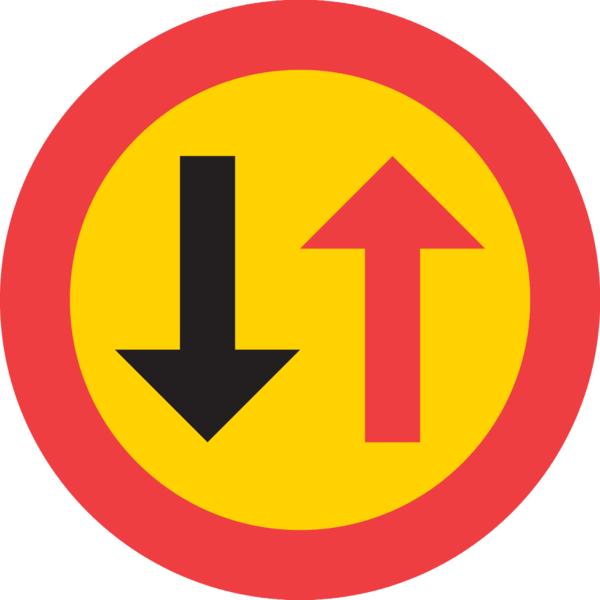
You approach a narrow bridge with the pictured sign. A vehicle approaches opposite; passing together would obstruct it. What do you do?
B6 places the give-way duty on the driver from this side.
Arrival order does not override B6.
B6 prohibits passage if oncoming vehicles would be obstructed. In this situation, wait and leave room for them. Do not force entry by relying on arrival order; check that the passage can be made safely.
What is the common function of the give-way signs (B family)?
This family does not regulate speed limits; the speed limit is indicated by sign C31.
The family also includes the pedestrian crossing and cycle crossing signs; the shapes also differ (the stop sign is an octagon, the priority road sign a diamond).
Under vägmärkesförordningen 2 kap. 6 §, the B family indicates the rules on giving way: give way (B1), stop (B2), pedestrian crossing (B3), priority road and end of priority road (B4, B5), give way to oncoming traffic and oncoming traffic gives way (B6, B7), cycle crossing (cykelöverfart, B8). So they show who must wait not only at junctions but also at pedestrian crossings and narrow passages. Their shapes are not uniform: the give way sign is an inverted triangle, the stop sign an octagon and the priority road sign a yellow diamond. They have nothing to do with speed limits.
More questions on this topic are in the app.