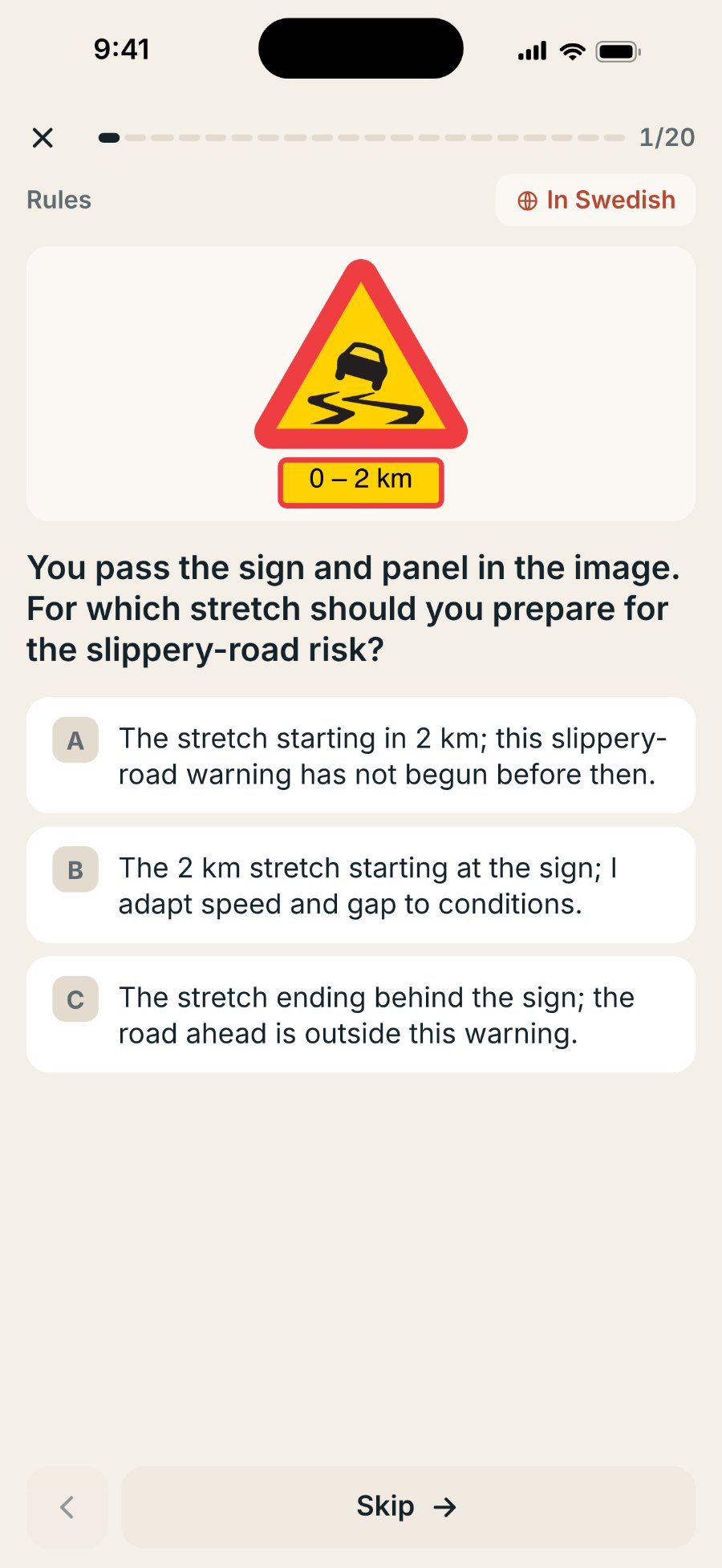
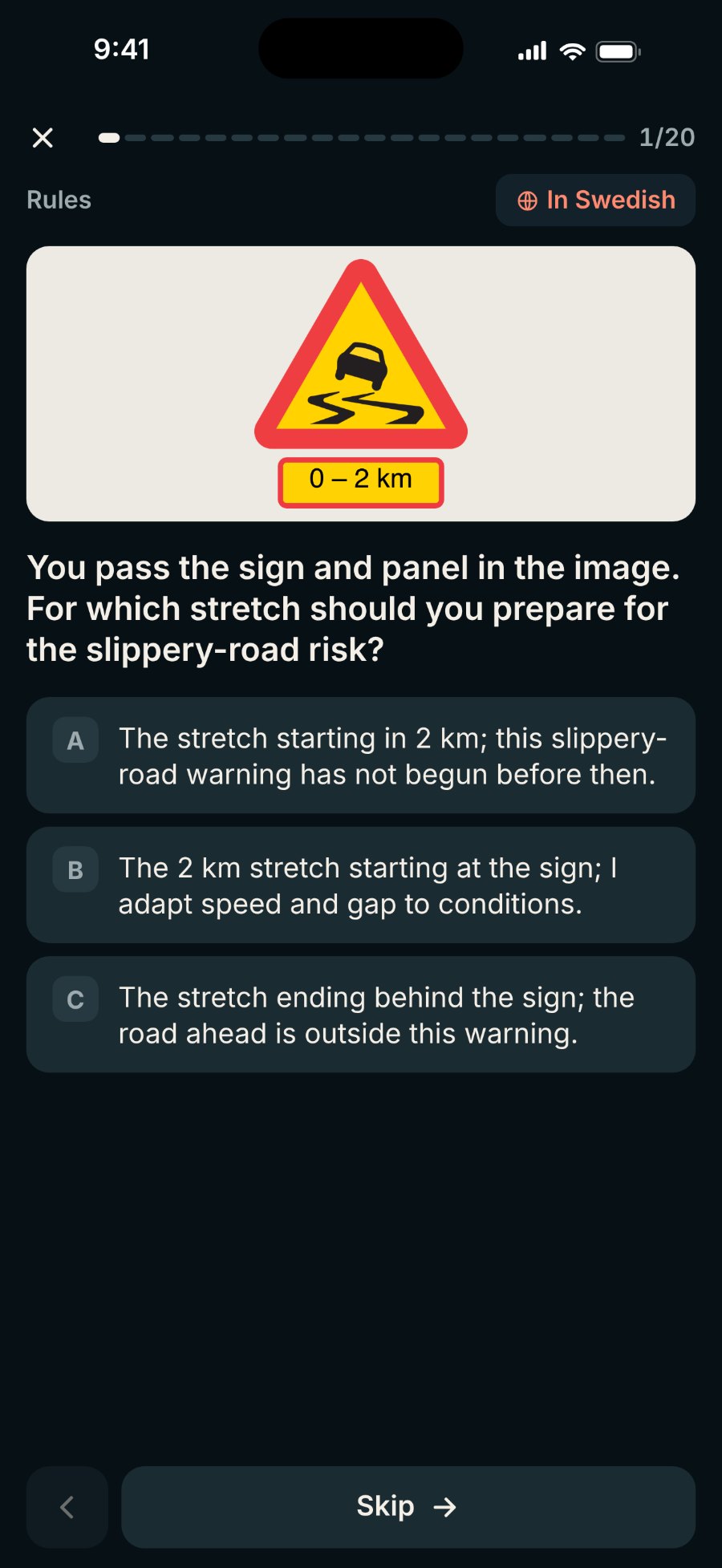
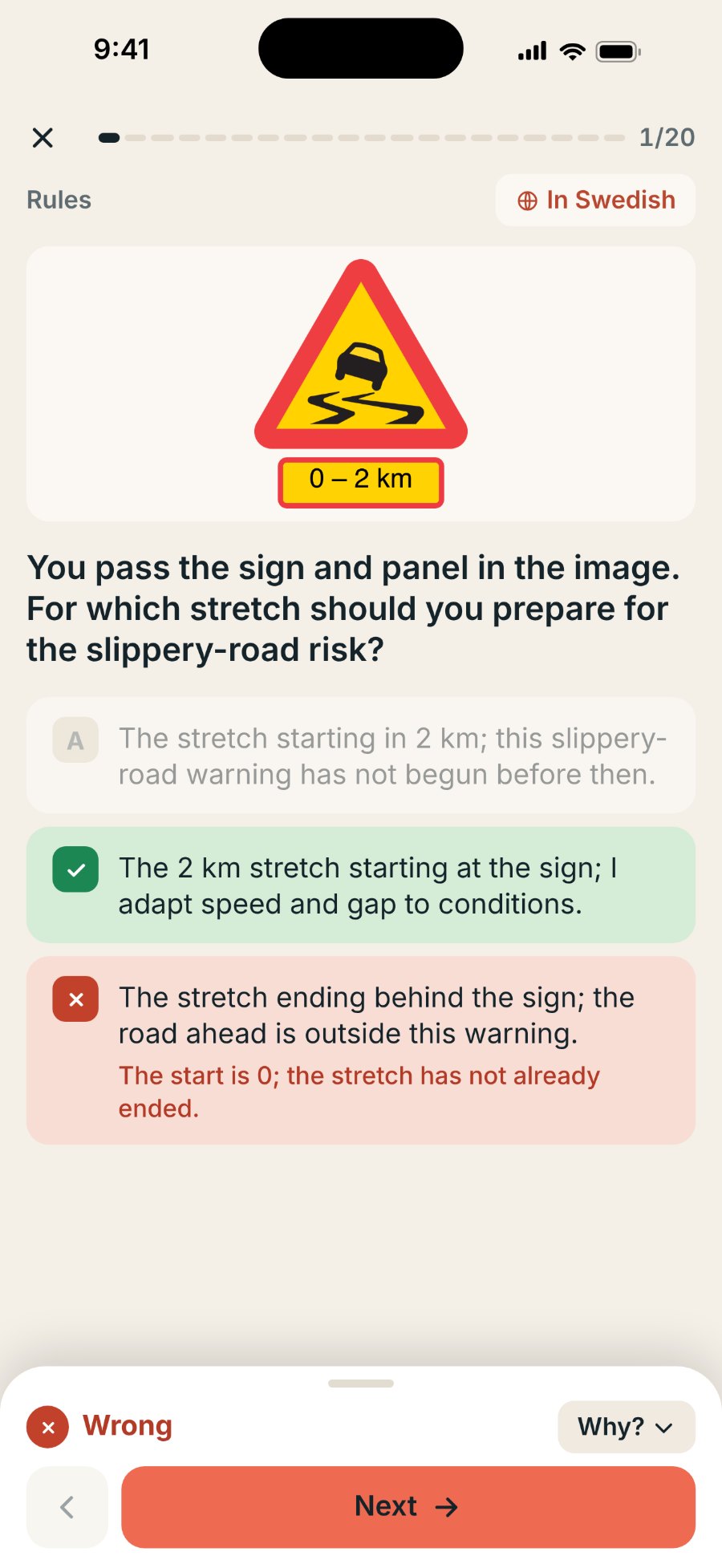
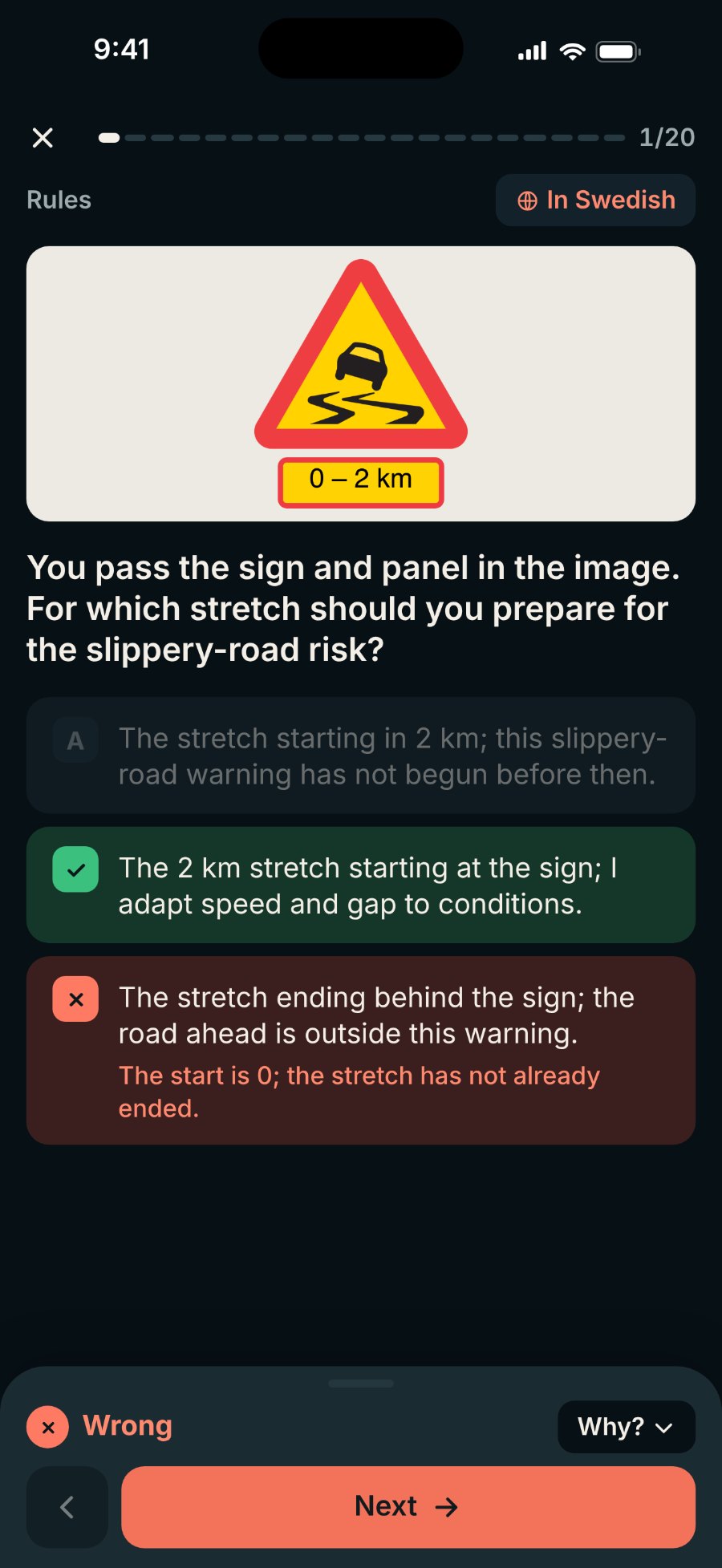
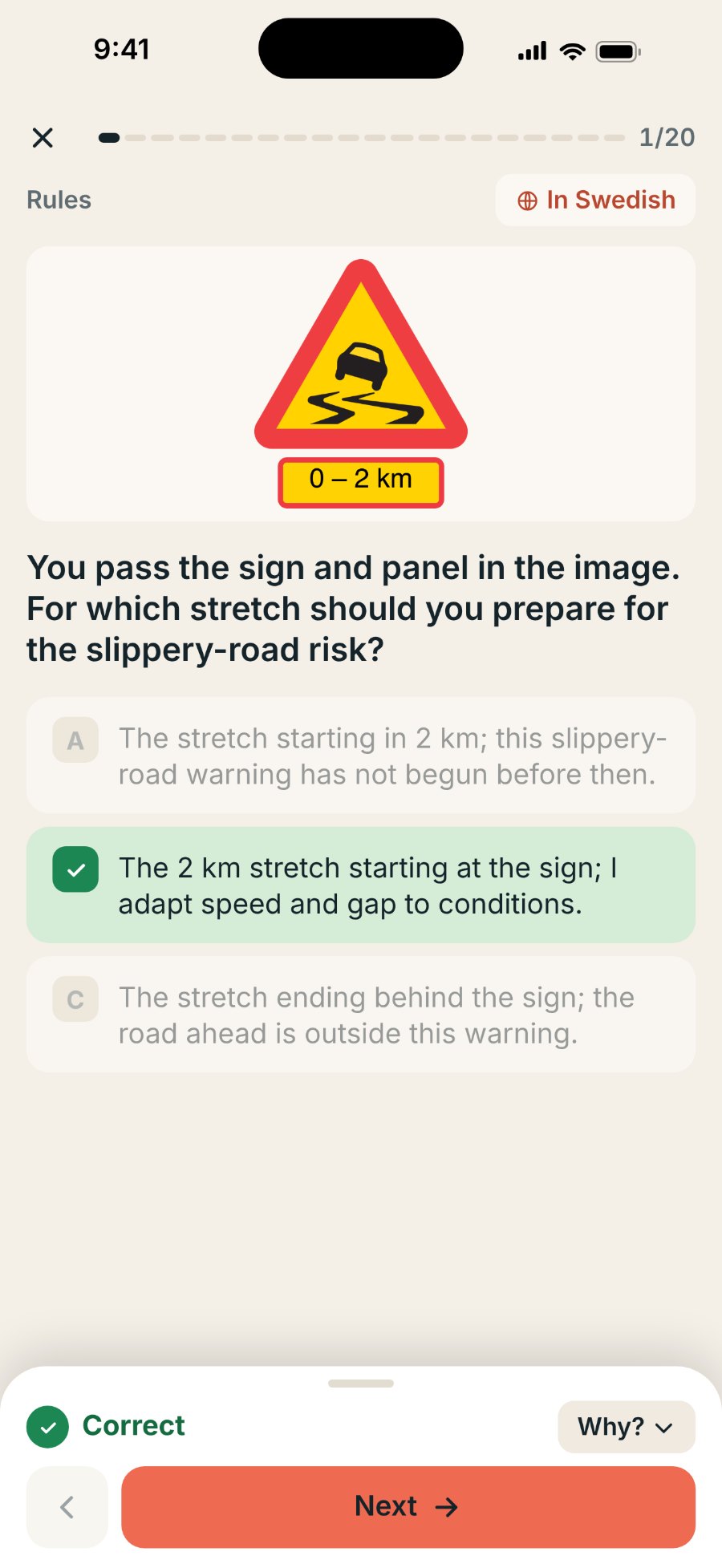
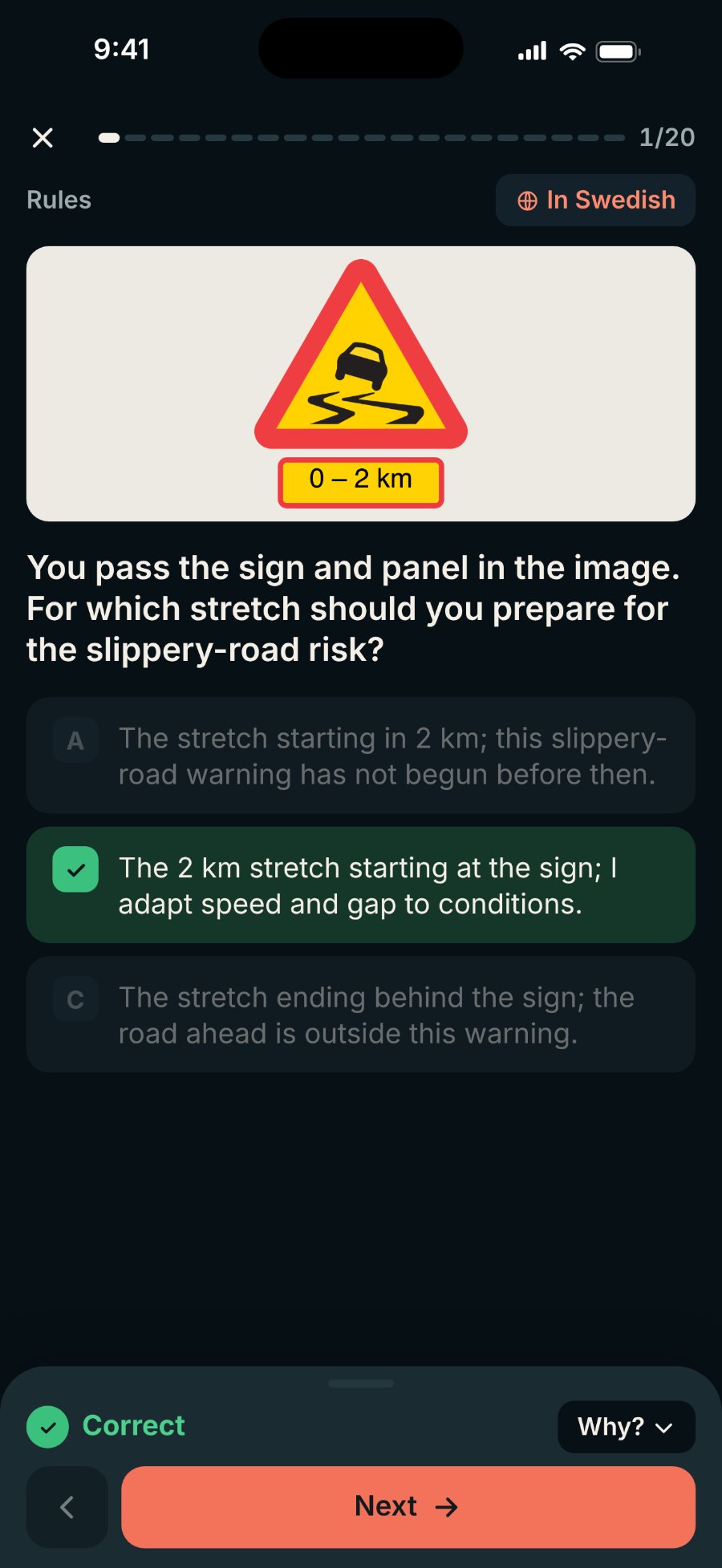
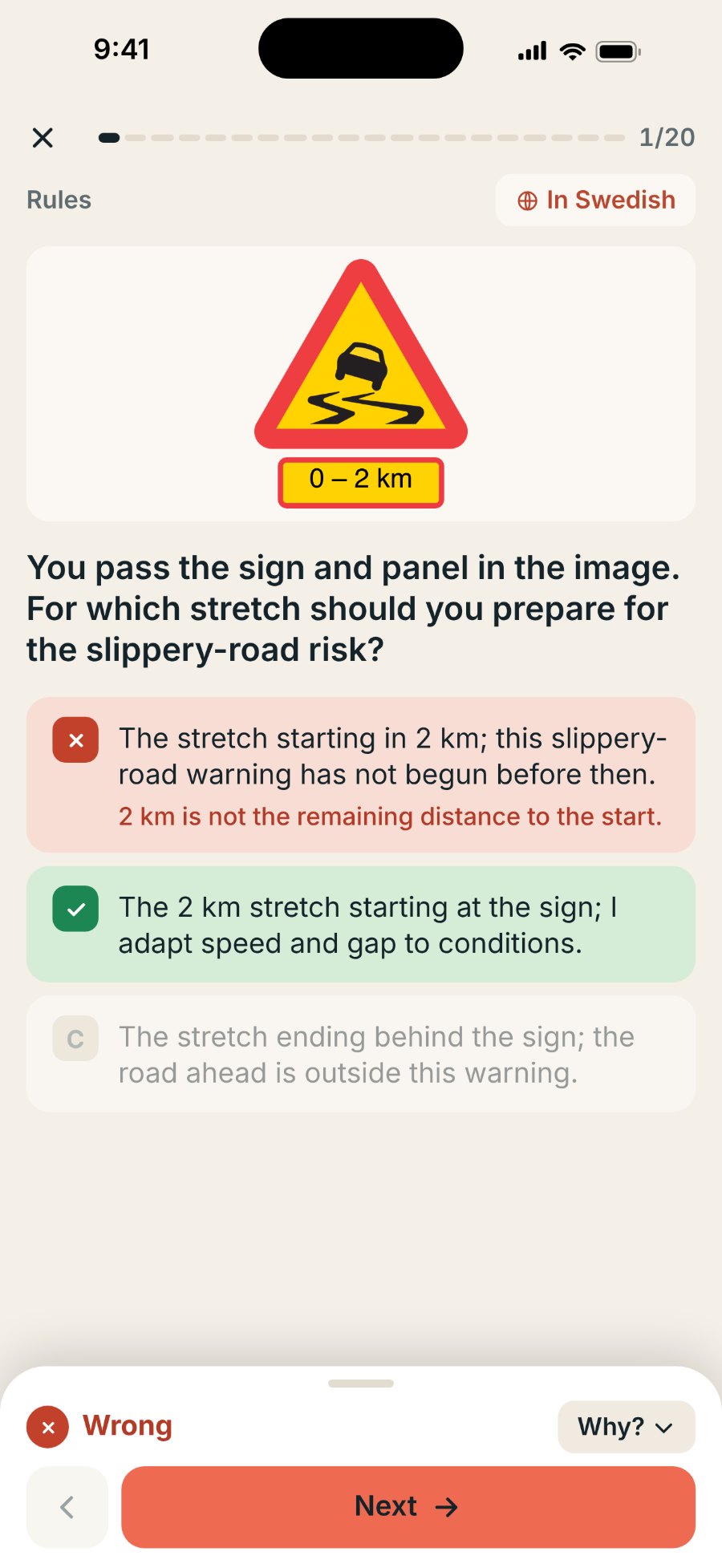
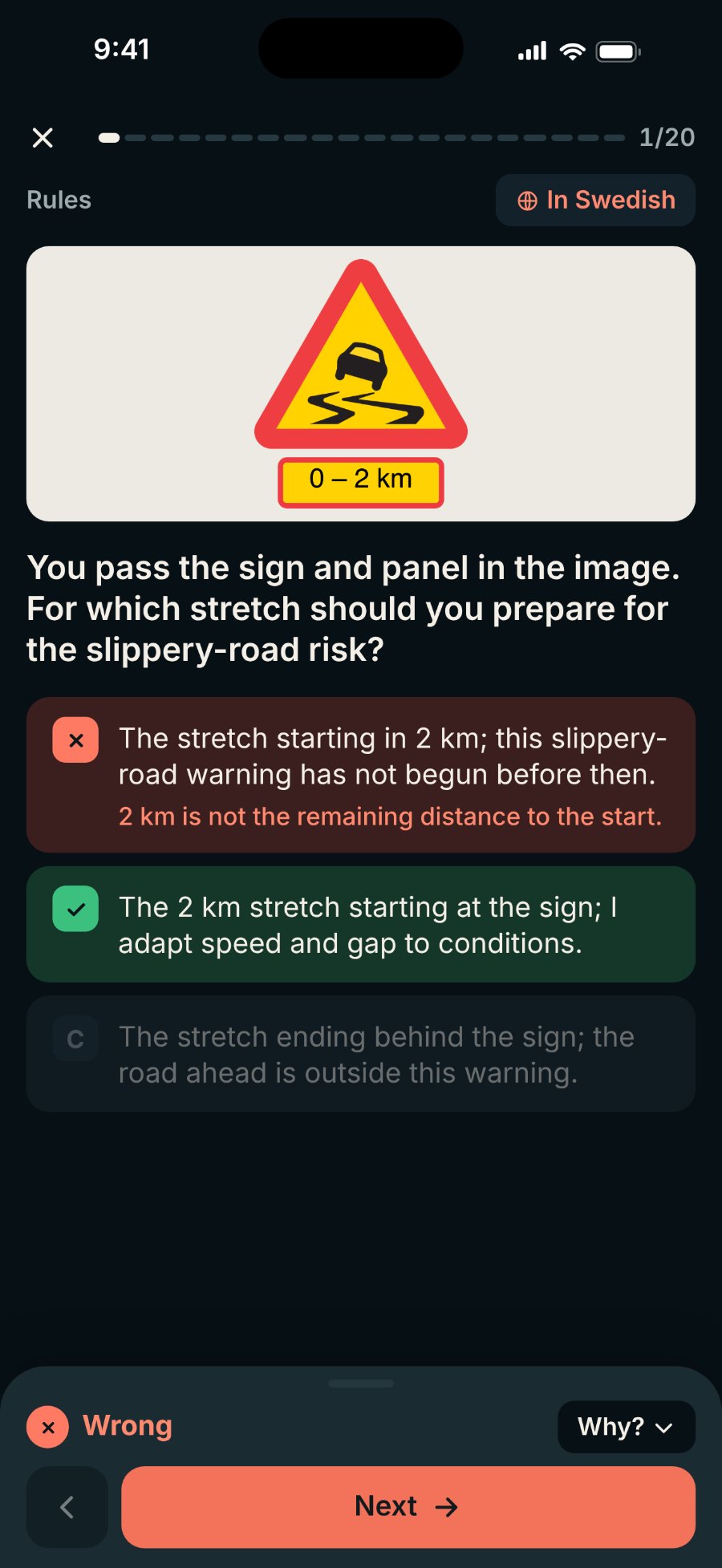
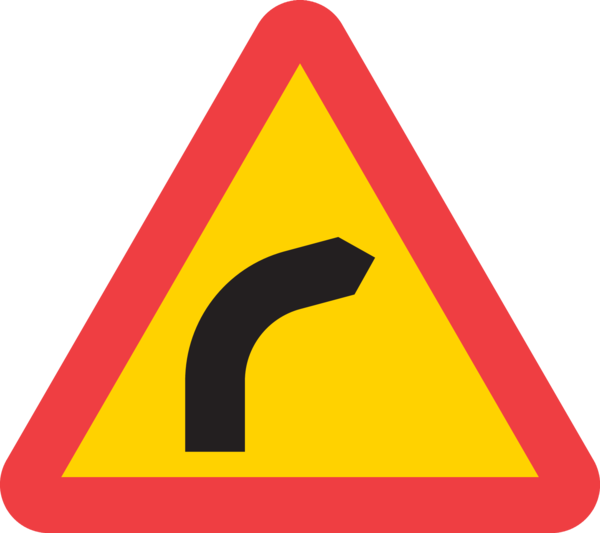
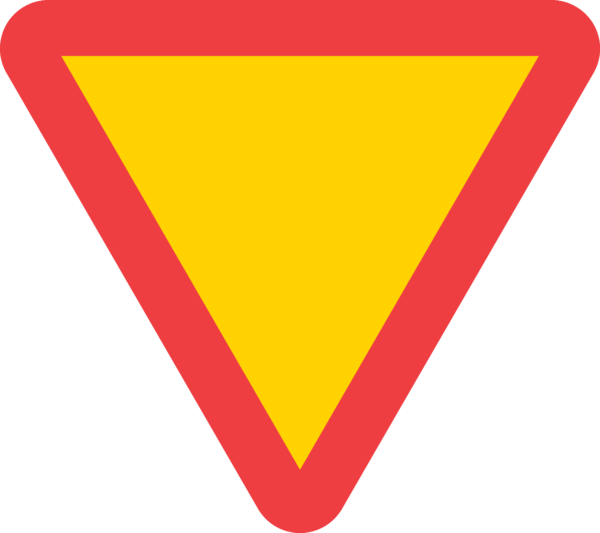
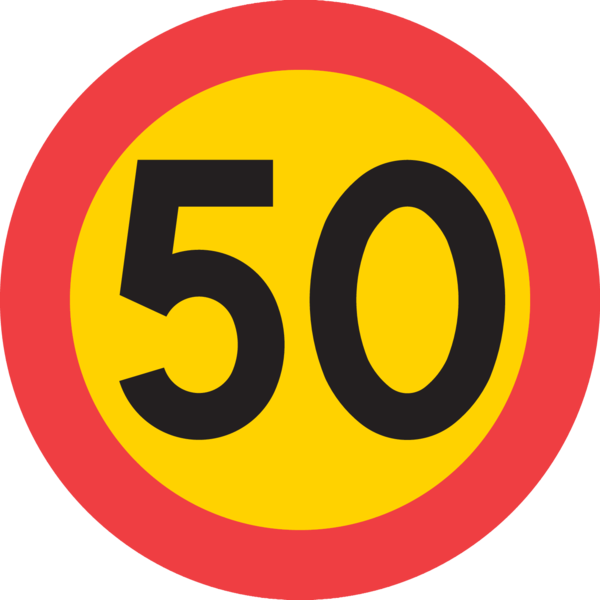
You pass the sign and panel in the image. For which stretch should you prepare for the slippery-road risk?
A The stretch ending behind the sign; the road ahead is outside this warning. B The 2 km stretch starting at the sign; I adapt speed and gap to conditions. C The stretch starting in 2 km; this slippery-road warning has not begun before then.
In the dark you can see about 40 metres ahead. Your reaction distance is 20 metres and your braking distance is 25 metres. Can you stop within the distance you can see?
A Yes; the 25-metre braking distance fits within 40 metres. B No; the stopping distance is about 45 metres. C Yes; the car already slows during the reaction time. D No; braking distance doubles in the dark.
You are turning left at the junction in the photo. The oncoming vehicle is going straight on. Who goes first?
A You; the driver who signals gets priority. B The oncoming vehicle; the turning driver gives way to it. C You; you entered the junction before the oncoming vehicle.
The sign in the picture is placed before a junction. What must you do?
A Go in any direction you like; the sign recommends that direction. B Continue straight ahead; the sign makes that direction compulsory. C Not continue straight ahead; the sign prohibits that direction.
Vehicle knowledge and manoeuvring In Swedish The engine warning light starts flashing while you are driving. What is it warning you about?
A A fault that can damage the catalytic converter under load. B An exhaust fault that can wait until the next routine service. C Low oil pressure, so the engine must be switched off at once.
In the situation in the photo, your lane ends ahead. What is the best course of action?
A Adjust to the vehicle on the left and move in behind it; when lanes merge, drivers adjust to each other. B Signal and move left at once; the driver who signals earns the right to change lanes. C Speed up and move in front of the vehicle on the left; the driver whose lane ends earns priority.
You leave your car at an authorised scrap reception point and receive a mottagningsbevis (certificate of receipt). Which is correct?
A You own the car until it has been scrapped. B The document shows the car has already been scrapped. C Whoever issued the document now owns the car.
It is an ordinary Saturday at 16:00. Are you allowed to park by the sign in the picture?
A Yes; on Saturdays the times in brackets, 8–15, apply. B Yes; on Saturdays the red times, 8–15, apply. C No; Saturday counts as a weekday, so 8–18 applies.
Road safety and behaviour In Swedish This is your view through the windscreen. What do you do?
A I slow down and turn on the windscreen demister. B I slow down and clean the glass with the washers and wipers. C I slow down and follow the brake lights of the car ahead.
Road safety and behaviour In Swedish You drive home straight after your last drink. While you drive, your blood alcohol is below 0.2 per mille, but when the police check you after you park, it is 0.3. What applies?
A It is not drink-driving, because the level was lower while you drove. B It is drink-driving, because the level after the drive also counts. C It is drink-driving only if you also drove unsafely.
You are approaching a junction with the sign in the picture. The crossing road is empty and you can see clearly both ways. What applies?
A You must stop completely before pulling out. B You must slow down in good time but need not stop. C You may pull out at the same speed, as the road is empty.
A loaded trailer without brakes has a maximum authorised mass of 750 kg but actually weighs 600 kg. The car's kerb weight is 1,000 kg and it is allowed to tow the trailer. The speed limit is 90 km/h. What is the fastest you may drive with the trailer?
A 80 km/h, as the maximum authorised mass is not over 750 kg. B 40 km/h, as the maximum authorised mass is over 500 kg. C 30 km/h, as the trailer has no brakes of its own.
What do you do in the situation shown?
A I slow down and get ready to stop. B I slow down, sound the horn and pass the animal quickly. C I keep my speed but move closer to the centre line.
You approach a narrow bridge with the pictured sign. A vehicle approaches opposite; passing together would obstruct it. What do you do?
A Enter; the oncoming vehicle must leave room for my passage. B Enter; whoever reaches the narrow part first gains priority regardless of the sign. C Wait before the narrow part; I must not pass in a way obstructing oncoming traffic.
In a slippery bend the ESP intervention indicator flashes. Which assessment is correct?
A I interpret intervention as confirmation that my chosen speed is safe for the grip. B I adapt speed and driving to grip without treating assistance as a guarantee. C I interpret the indicator as proof that the system increased tyre-to-road grip.
Vehicle knowledge and manoeuvring In Swedish The car is facing a wall with its dipped headlights on. What does the light pattern on the wall show?
A The dipped headlights are made for left-hand traffic. B The headlights are badly aimed and need adjusting. C The dipped headlights are made for right-hand traffic.
Your plug-in hybrid passenger car is Euro 6. You want to enter a class 3 environmental zone in electric mode. No exemption applies. Which is correct?
A Electric mode makes the car an electric-only vehicle for this zone. B Euro 6 permits the plug-in hybrid passenger car to enter this zone. C Neither electric mode nor Euro 6 permits this hybrid passenger car to enter.
The pictured line separates you from oncoming traffic. A slow vehicle drives ahead and no special exception applies. May you drive onto it to overtake?
A Yes; a slow vehicle counts as a physical obstruction permitting crossing the line. B Yes; adequate visibility removes the line’s binding effect. C No; ordinary overtaking is no exception permitting crossing this line.
What do you do in the situation shown?
A I keep my speed, as the person is walking beside the carriageway. B I slow down and pass once I can leave a wide margin. C I slow down and move into the oncoming lane if I see no lights.
The engine suddenly cuts out while the car is still moving. What can happen if you switch off the ignition and take the key out before the car has stopped?
A The steering lock may engage, so you cannot steer. B The brakes stop working completely, however hard you press. C Nothing much, since the engine has already stopped.
Your result
0 80% to pass (16 of 20) 100%
Tap a question to see your answer and the explanation again.