
Signs and signals · 4/17
- Warning signs
- Give-way signs
- Prohibitory signs
- Mandatory signs
- Information and regulation signs
- One-way road
- Direction signs
- Hierarchy of rules
- Information signs
- Level crossing
- Road markings
- Signals from officers
- Traffic lights
- Additional panels
- Reading times on an additional panel
- Road works area
- Road works equipment
Mandatory signs
2 min read
A blue round sign gives a mandatory instruction. It is not advice: you obey it, and ignoring it is an offence.
A mandatory sign () has a blue background and is round, and its white symbol shows what must be done. A prohibitory sign is round with a red border, its background is mostly yellow, and it shows what must not be done. The colour code decides the function.
Mandatory direction
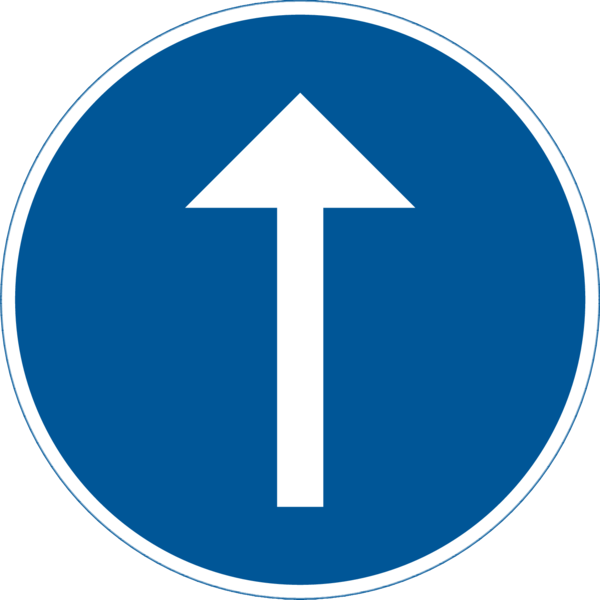
The shape of the arrow is adapted to the place. An arrow that goes up and then curves to the right allows driving to the right only.
- Your route going straight, satnav, looking for an address, signalling or being in the wrong lane are not exceptions.
- You obey the sign and plan your route again using permitted roads.
- Obeying the sign does not guarantee that the turn is safe. You check for pedestrians and other traffic.
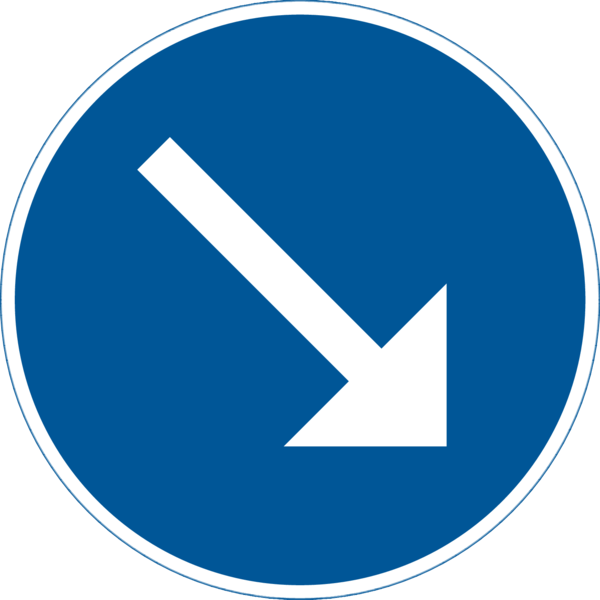
D2 does not guarantee that the space on the right is safe in every condition. If a real obstacle or danger appears, you do not move forward just to obey the sign.
Roads reserved for particular traffic
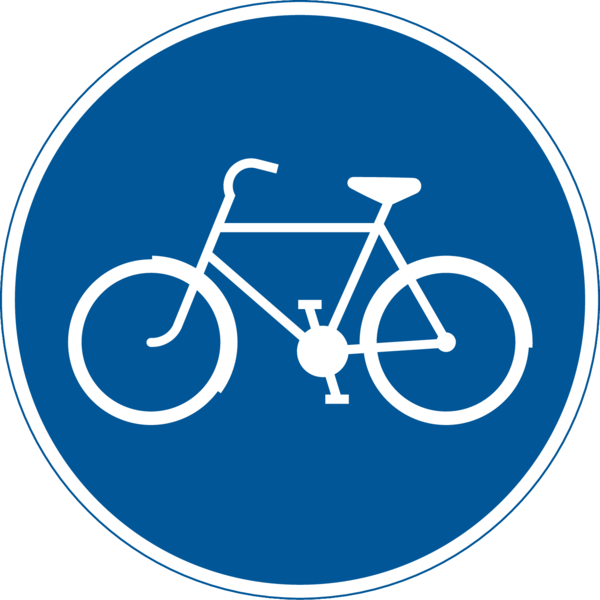
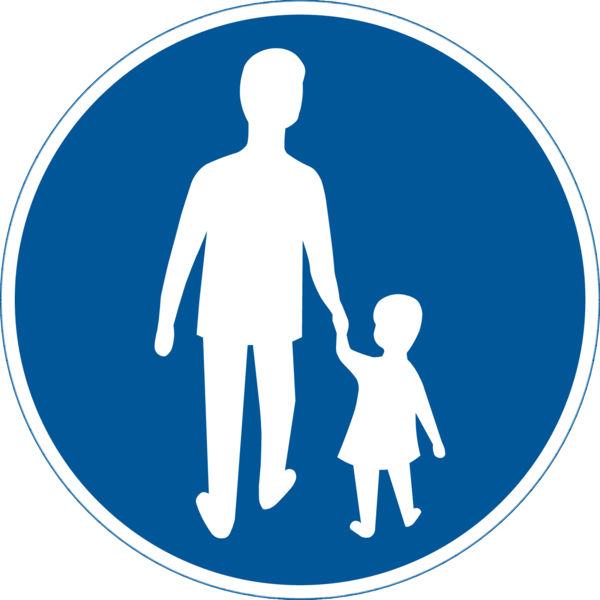
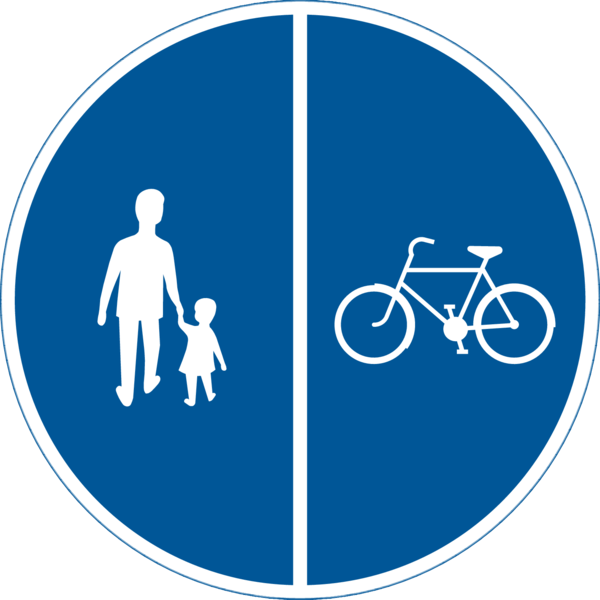
In a car, you do not drive along these paths and you do not use them as a shortcut. Not seeing any pedestrians or cycles, and driving slowly, do not make it allowed. You may enter the path only to cross it, and you do that safely.
Unless an additional panel says otherwise, a class II moped may use the cycle side. Cyclists being able to choose the carriageway in some conditions does not open the cycle track to a car.
What the law says
Påbudsmärken som anger att ett visst slag av trafik är påbjuden anger även förbud mot annan trafik, om inte annat är föreskrivet.Unofficial translation: Mandatory signs that indicate that a certain kind of traffic is mandatory also indicate a ban on other traffic, unless otherwise prescribed.
2 kap. 9 § vägmärkesförordningen
Try it yourself
2 questions from this lesson, no sign-in.
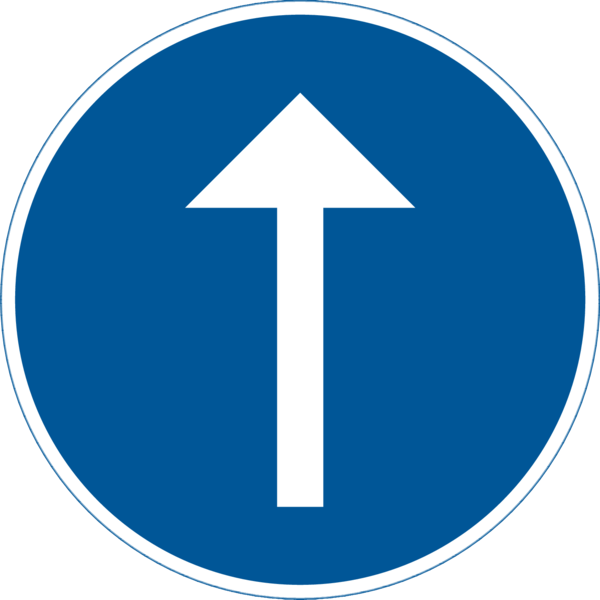
The sign in the picture is placed before a junction. What must you do?
A mandatory sign is not a recommendation; it is binding.
Prohibitory signs have a red border; a blue sign indicates a mandatory requirement.
Round signs with a blue background indicate mandatory requirements; the white arrow on this sign (D1) shows the direction you must go, and the vehicle may only be driven in the direction of the arrow. Not complying is an offence. Prohibitory signs, on the other hand, mostly have a red border and a yellow background (blue for parking and stopping prohibitions); signs giving recommendations have a different shape and colour.
You are approaching a junction with traffic lights. The sign in the picture is before the junction. The light is green and you want to turn right. What do you do?
The light only overrides stop and give-way signs.
Turning right is not allowed here, whether or not anyone is in the way.
Sign D1 means you may only drive in the direction of the arrow (2 kap. 10 § vägmärkesförordningen). A green light takes priority over stop and give-way signs, but it does not cancel a sign telling you which way to drive (2 kap. 2 § trafikförordningen).
More questions on this topic are in the app.