
Signs and signals · 13/17
- Warning signs
- Give-way signs
- Prohibitory signs
- Mandatory signs
- Information and regulation signs
- One-way road
- Direction signs
- Hierarchy of rules
- Information signs
- Level crossing
- Road markings
- Signals from officers
- Traffic lights
- Additional panels
- Reading times on an additional panel
- Road works area
- Road works equipment
Traffic lights
2 min read
A yellow light means stop, it is not extra time. A green light does not guarantee that the way is clear either.
| Light | What do you do? |
|---|---|
| Yellow | You stop. If you have gone so far that you cannot stop without causing danger, you go through. |
| Flashing yellow | You pass with special care. If there is a sign, you obey it. |
| Green | You may proceed, and you prevent any danger you see. |
| Green arrow | It is permission for the direction of the arrow. It is not permission to put a pedestrian in danger. |
| Off | The previous light is void. If there is no sign or officer, the general rule applies. |
The narrow exception on yellow
The exception is that, when the light changes from green to yellow, you have gone so far that you cannot stop without causing danger. For example, if hard braking would cause a rear-end collision or a skid. Then you cross the line and clear the junction. You do not need to speed up, and speeding up is a separate danger. Seeing yellow from far away and speeding up is an offence.
Flashing yellow
It does not cancel a STOP sign, and it does not give you priority. If there is a sign and a stop line, you stop at the line and go when the conditions for giving way are met. You do not wait for green. A steady light comes before a stop sign, a flashing yellow does not.
If the exit is full on green
If you would enter and then be stuck in the junction, blocking the crossing traffic, you wait before the junction until there is room at the exit. Pressure from behind or a horn does not change this.
Pedestrian on a green arrow
If a pedestrian who started to cross earlier on green is still finishing the crossing on the way back, you give them the chance to finish safely. A horn does not replace this.
If the lights are off
The last light the signal showed has no effect. If there is also no sign or officer, the rule of priority to the right () applies. You also check that it is safe to enter the junction. The width of the road does not create priority, a priority road is set only by a sign. A light being off does not forbid passing. If there is a sign or an officer, that regulation applies.
What the law says
Stanna. Fordon får inte passera stopplinjen eller, om sådan saknas, signalen i annat fall än då det hunnit så långt fram när signalbilden växlar från grön till gul att det inte kan stannas utan fara.Unofficial translation: Stop. A vehicle may not pass the stop line or, if there is none, the signal, except where it has gone so far when the signal changes from green to yellow that it cannot stop without danger.
3 kap. 6 § vägmärkesförordningen
Try it yourself
2 questions from this lesson, no sign-in.
The traffic lights change from green to amber as you approach the stop line. Which is correct?
Amber already means stop. Beating the red light is not enough.
A clear junction gives no right to drive on at amber.
Amber means stop. You may cross the stop line only if you were so far forward when the light changed from green to amber that you cannot stop without danger (3 kap. 6 § vägmärkesförordningen).
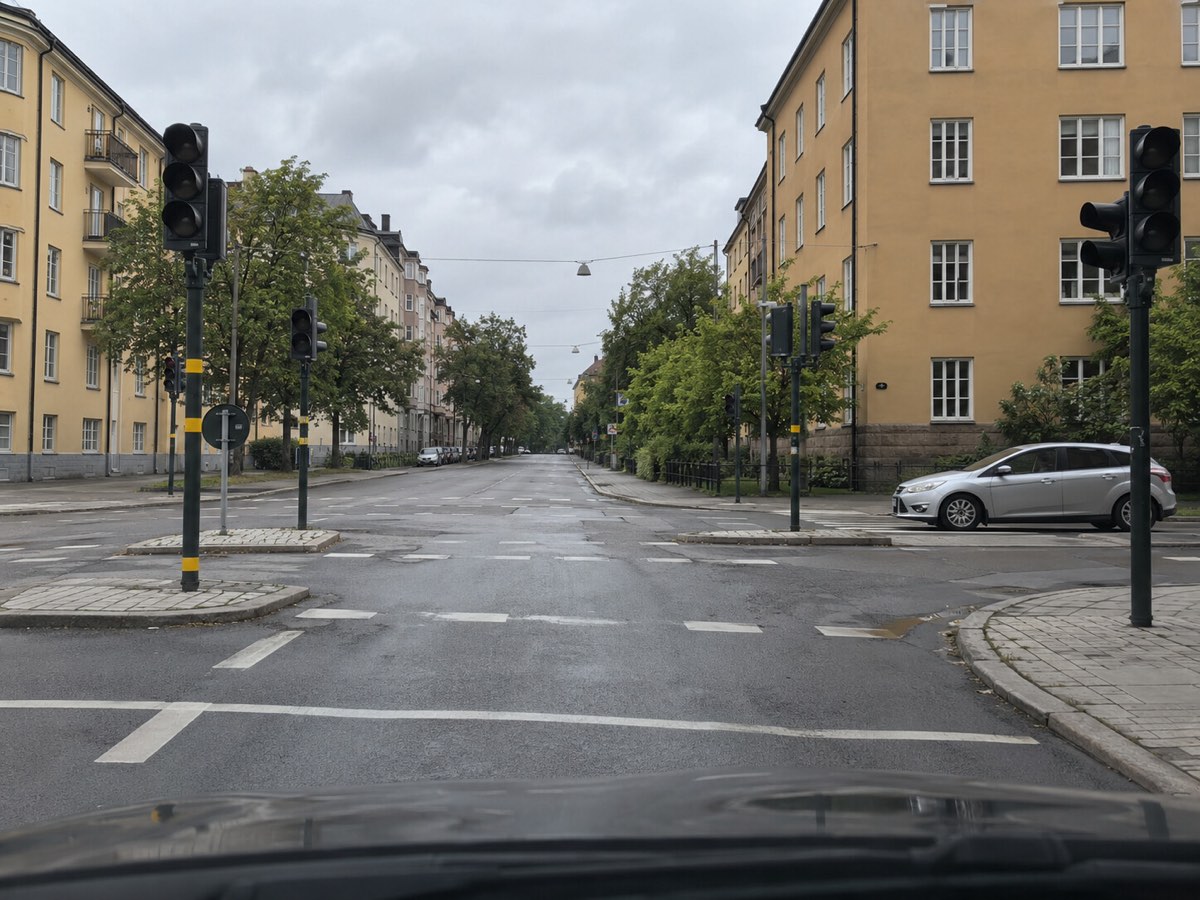
The traffic lights at the junction in the photo are out and there are no signs. Which rule applies?
The last light shown by traffic lights that have gone out has no legal effect.
The width of the road does not create priority; a priority road is only established by a sign.
If the traffic lights are not working, there is no special arrangement at that junction; if there are no signs either, the general rule, priority to the right, applies. You give way to the vehicle on the right arm. The last light shown by the traffic lights has no legal effect, and the width of the road does not create priority either.
More questions on this topic are in the app.