
Signs and signals · 9/17
- Warning signs
- Give-way signs
- Prohibitory signs
- Mandatory signs
- Information and regulation signs
- One-way road
- Direction signs
- Hierarchy of rules
- Information signs
- Level crossing
- Road markings
- Signals from officers
- Traffic lights
- Additional panels
- Reading times on an additional panel
- Road works area
- Road works equipment
Information signs
2 min read
Signs that give information set no rules. You take in the information and adjust your behaviour to it.
The difference between J and E
| Family | What does it do? |
|---|---|
| J | Gives information that matters for traffic flow or safety and cannot be given another way (J2). Shows a dangerous power line over the road (J3). Sets no rule. |
| E | Shows the condition, the traffic rule, that applies at a place or on a stretch of road. Most apply until an end sign. |
The difference is not in enforcement, it is in what the sign shows. Some E signs start a package of rules: motorway (E1), built-up area (E5), pedestrian street (E7). Others show a situation, such as a dead end (E17) or a tunnel (E26).
Service signs
The rest area (H13) and fuel (H3) signs show the position of a service facility. They belong to the H family, not the J family. They set no binding rule. Give-way, stop, speed limit and parking ban signs, on the other hand, are binding.
H13 helps you plan a break. It is not an order for everyone to stop, and it is not reserved only for heavy vehicles. If tiredness is stopping you driving safely, you stop in a safe way without waiting for a sign further on.
Emergency telephone
G2 shows the position of an emergency telephone. It is not specific to a group of vehicles. It is also not an order to use that telephone for every breakdown. It does not lift the stopping bans: you do not stop dangerously on the road and you do not enter a forbidden area. From a safe position, you use a suitable way of getting help.
A warning does not set a speed limit either
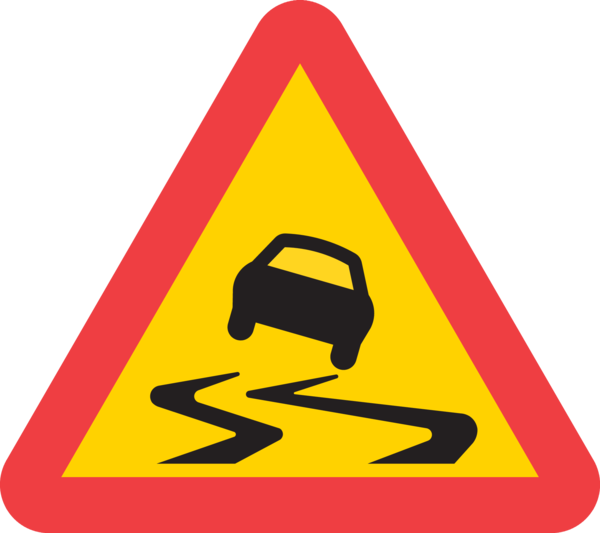
The duty to adapt your speed to the conditions comes from the general rule. You change your behaviour because the sign shows the risk. A speed limit is set by a separate sign.
What the law says
Märket ger upplysning av väsentligt intresse för framkomlighet eller säkerhet som inte kan ges på annat sätt.Unofficial translation: The sign gives information of essential interest for traffic flow or safety that cannot be given in any other way.
2 kap. 27 § vägmärkesförordningen
Try it yourself
1 questions from this lesson, no sign-in.
An information sign (J2) shows a prohibition sign and the text “800 m”. Where does the prohibition start?
800 m is the distance to the prohibition, not its length.
The information sign only gives advance warning. The ban starts at the actual sign.
A prohibition sign shown on an information sign (J2) is advance information (2 kap. 27 § vägmärkesförordningen). The prohibition applies from where the actual prohibition sign stands (2 kap. 7 §). The 800 m tells you how far away that is.
More questions on this topic are in the app.