
Signs and signals · 6/17
- Warning signs
- Give-way signs
- Prohibitory signs
- Mandatory signs
- Information and regulation signs
- One-way road
- Direction signs
- Hierarchy of rules
- Information signs
- Level crossing
- Road markings
- Signals from officers
- Traffic lights
- Additional panels
- Reading times on an additional panel
- Road works area
- Road works equipment
One-way road
3 min read
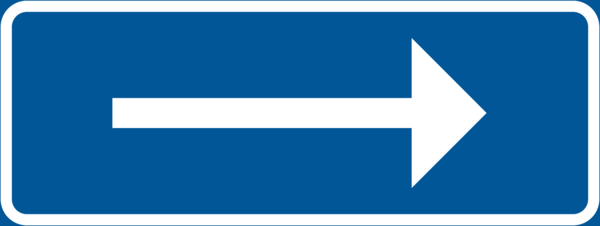
On a one-way road, vehicle traffic flows only in the direction of the arrow. If you entered the wrong way, you do not continue. You stop safely and work out the way out.
Tell the signs apart
- E16 shows the direction of traffic. It is not an order to turn right at the next junction, that is the job of D1.
- C1 forbids entry by vehicle. It can be used to prevent entry from the wrong direction. It shows where you cannot enter, not the permitted direction.
- One-way is a regulation, not a warning. It is shown with the blue E16, not with a yellow triangular sign.
- E16 is used on a road where all oncoming vehicle traffic is banned. You still stay alert for vehicles in the wrong direction and for pedestrians.
If there is a C1 except cycles at the far end and no E16, this does not make the whole road one-way. You expect that a cycle may come towards you. This also gives the cyclist no unconditional priority, and the duties of safety and giving way still apply.
If you entered the wrong way
You end driving the wrong way without increasing the danger. First you stop in a controlled way at a safe place and check around you and behind you. You may turn or reverse only if it causes no danger or obstruction to others. Reversing blindly is not automatically the right solution. Hazard warning lights or a horn do not make driving the wrong way allowed.
Overtaking
As a rule, you overtake on the left, and the road being one-way does not change that by itself. No oncoming traffic does not free you to pass on the right either.
- Passing on the right is allowed on a road with a limit of at most 70 km/h and at least two marked lanes in the same direction.
- You also pass on the right if the vehicle in front is turning left or preparing to.
- The restriction on using the left lanes does not apply on a one-way road.
- The overtaking bans at a pedestrian crossing and before a junction still apply.
Leaving the street
When you turn from a one-way street into a two-way road, you check both relevant directions of the road you are joining and the pavement. Your own street being one-way does not limit the traffic on the road you join, and it does not limit a pedestrian on the pavement to one direction.
Parking
On a one-way road, you can also stop and park on the left-hand side. The other stopping and parking rules still apply.
What the law says
Märket anger att fordonstrafiken på vägen är enkelriktad i pilens riktning.Unofficial translation: The sign indicates that vehicle traffic on the road is one-way in the direction of the arrow.
2 kap. 12 § vägmärkesförordningen
Try it yourself
2 questions from this lesson, no sign-in.
You are driving on a one-way street with two lanes and are going to turn left at the next junction. Where do you position the car?
Keeping to the middle applies on roads with two-way traffic.
Before a left turn, move into the left-hand lane in good time.
On a one-way carriageway, keep as close to its left-hand edge as possible when turning left (3 kap. 26 § trafikförordningen). With several lanes, move into the left-hand one in good time (3 kap. 25 §). Keeping close to the middle is for roads with two-way traffic.
You accidentally entered against one-way traffic. Ahead is space to stop safely. What is the first suitable action?
Wrong entry does not guarantee safe reversing.
The horn does not permit continuing the wrong way.
End wrong-direction travel without increasing danger and use the safe stopping opportunity under control. Any later reversing or turning is allowed only without danger or obstruction to other road users. A universal reversing instruction would ignore differing road and visibility conditions.
More questions on this topic are in the app.