
Signs and signals · 5/17
- Warning signs
- Give-way signs
- Prohibitory signs
- Mandatory signs
- Information and regulation signs
- One-way road
- Direction signs
- Hierarchy of rules
- Information signs
- Level crossing
- Road markings
- Signals from officers
- Traffic lights
- Additional panels
- Reading times on an additional panel
- Road works area
- Road works equipment
Information and regulation signs
2 min read
E signs tell you the condition that applies at a place or on a stretch of road. Some start a package of rules even though they carry no number.
Entering a built-up area
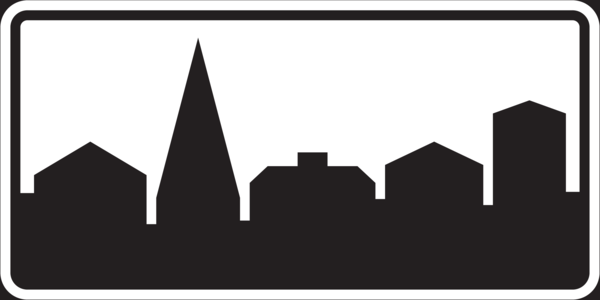
- If there is no other speed regulation, the upper limit is 50 km/h. If you are driving at 70 km/h, you slow down.
- 50 is not a target speed. Visibility, pedestrians and road conditions may require a lower speed.
- The municipality can set 30 or 40 km/h, but it announces this with a sign that shows the number. 30 is not the general limit of a built-up area.
- When you approach a bus that signals to pull away from a stop, you slow down and let it leave. If needed, you stop.
- A prohibitory sign placed together with E5 applies in the whole built-up area, unless stated otherwise for a specific road.
Leaving a built-up area
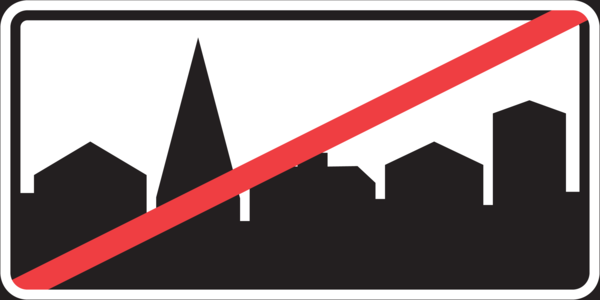
| Rule | After E5 | After E6 |
|---|---|---|
| Basic upper limit | 50 km/h | 70 km/h |
| Giving way to a bus pulling away from a stop | Applies | Ends |
The two are linked: the bus rule applies on roads where the speed limit is 50 km/h or lower. When the limit goes up to 70, this duty also ends.
The basic limit of an ordinary road outside built-up areas is not 90. 90 is shown with a separate sign. 70 is not a target speed either. Motorway limits and special vehicle limits are assessed separately.
Who cannot enter a motorway?
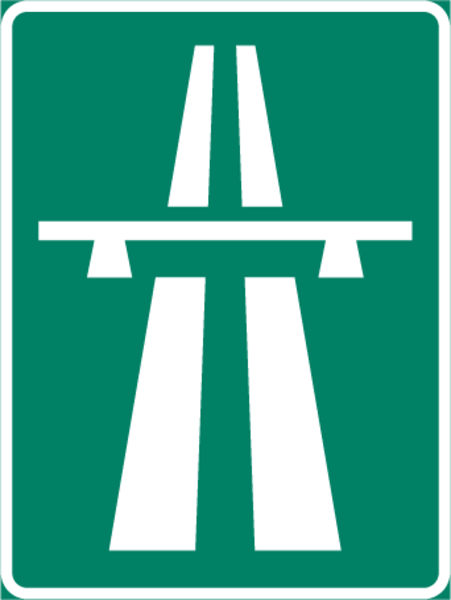
Motor vehicles built for at least 40 km/h and allowed to be driven at that speed may enter a motorway. Class I mopeds are also banned: even if one can do 45 km/h, it cannot enter.
Parking on a one-way street
The general rule is to stop and park on the right-hand side. On a one-way road there is an exception for the left-hand side. This does not mean every space on the left is allowed. The closeness to junctions and crossings, blocking the way and local restrictions still apply.
What the law says
Där den högsta tillåtna hastigheten är 50 kilometer i timmen eller lägre, skall en förare som närmar sig en buss, vars förare ger tecken för att starta från en busshållplats, sakta ner och ge bussen möjlighet att lämna hållplatsen.Unofficial translation: Where the highest permitted speed is 50 kilometres per hour or lower, a driver approaching a bus whose driver signals to pull away from a bus stop shall slow down and give the bus the opportunity to leave the stop.
3 kap. 45 § trafikförordningen
Try it yourself
2 questions from this lesson, no sign-in.
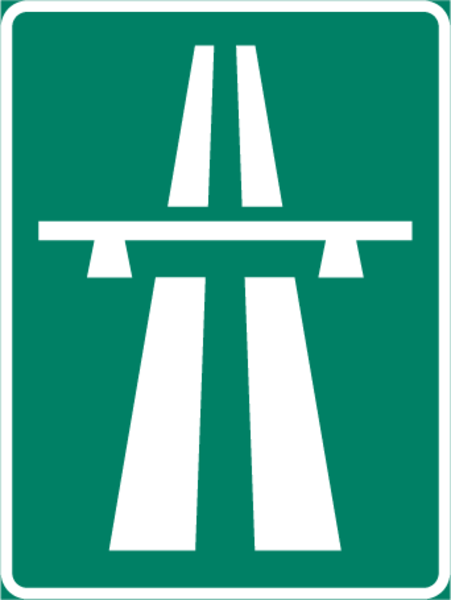
Which vehicle may not enter the road beginning at this sign, even though it is designed for 45 km/h?
A car meeting the requirements is not covered by the moped prohibition.
A motorcycle meeting the requirements is not a class I moped.
The sign indicates a motorway. In addition to the requirement for motor vehicles to be designed and permitted to travel at least 40 km/h, class I mopeds are specifically prohibited. Being able to travel at 45 km/h does not grant access. This asks about vehicle-class access, not current speed or the speed limit.
You want to park on the left-hand side of a one-way street, six metres from a crossing carriageway. What applies?
The limit is ten metres from the nearest edge of the crossing carriageway.
On a one-way road you may also park on the left.
On a one-way road you may also stop and park on the left-hand side (3 kap. 52 § trafikförordningen). The ban on stopping or parking within ten metres of a crossing carriageway still applies on both sides (3 kap. 53 §).
More questions on this topic are in the app.