
Lane position · 5/5
U-turns and reversing
2 min read
You may make a U-turn or reverse only if it causes no danger or obstruction to others. Both are forbidden on a motorway and on a road for motor vehicles.
On an ordinary road
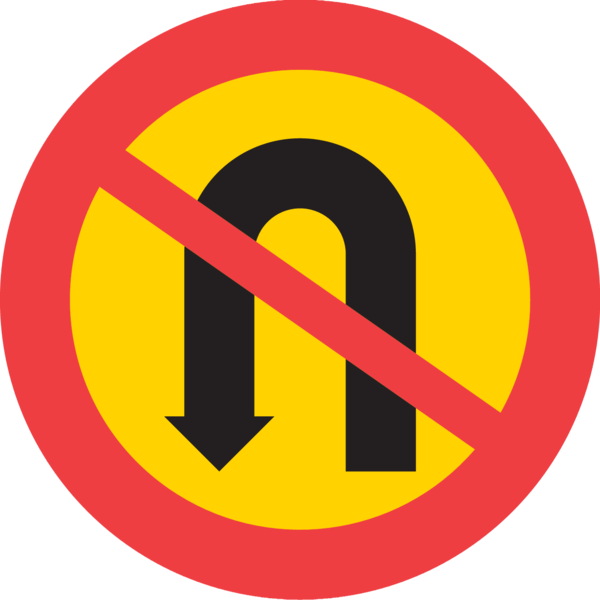
The test is the same for a U-turn () and for reversing (): there must be no danger or obstruction to other road users. A short distance, hazard warning lights () or a camera do not meet this assessment on their own.
A narrow street does not create a ban by itself. The responsibility is yours: if the manoeuvre is safe, it is allowed.
Near the crest of a hill, if you cannot see oncoming traffic well enough, you do not turn. You choose another place. Even when there is no separate ban, a safe manoeuvre is required. Being safe does not remove a specific ban.
On a motorway and a road for motor vehicles
On a motorway () and on a road for motor vehicles (), you cannot turn or reverse in a passenger car. A normal 90 km/h road does not count as one of these roads just because of its speed.
If you missed your exit, you continue forward to the next exit. A short distance does not give you permission to reverse. You also cannot use the central reservation or the connecting road between the carriageways for this.
Continuous centre line
If you would have to cross into the oncoming lane to turn back and the centre line is continuous, you cannot turn. The exceptions the law lists are: passing an obstacle, lack of space at a junction, entering or leaving a property, and a broken line directly to the right of the line. Turning back is not one of them.
No oncoming vehicle does not change this, because the ban depends on the marking. You turn at a suitable place where the line is broken.
On a one-way road
If you entered in the permitted direction but the route is wrong, you do not make a U-turn and continue the wrong way. You keep going in the permitted direction and look for a lawful way out. An empty road or hazard warning lights do not allow it.
What the law says
En förare får vända eller backa endast om det kan ske utan fara eller hinder för andra vägtrafikanter.Unofficial translation: A driver may turn or reverse only if it can be done without danger or obstruction to other road users.
3 kap. 46 § trafikförordningen
Try it yourself
2 questions from this lesson, no sign-in.
On an ordinary road with no separate reversing prohibition, what general condition is required for reversing?
Hazard lights do not replace the no-danger/no-obstruction condition.
A short distance alone is insufficient.
Reversing must be possible without danger or obstruction to other road users. Short distance, hazard lights or a camera does not alone meet that assessment. There is no separate prohibition here; safety does not cancel a specific prohibition.
You have taken the wrong exit from a road for motor vehicles (motortrafikled) and are still on the slip road. What are the rules on turning round or reversing there?
Even without danger or obstruction, both are banned on the slip road.
The ban on reversing covers the hard shoulder too, with or without hazard lights.
The ban on turning round and reversing on a motortrafikled also applies on its slip roads (9 kap. 1 och 2 §§ trafikförordningen). It applies on the hard shoulder too, whether or not your hazard warning lights are on. Carry on to the end of the slip road and find another way back.
More questions on this topic are in the app.