
Lane position · 3/5
Position in the lane
3 min read
Normally, you drive in the right-most lane that is suitable for you. Before a turn, you position yourself in good time for the direction of the turn.
In normal driving
- If there is one lane in each direction, you drive in your own lane, in the right half of the road. You do not move to the middle or the opposite side because no vehicle is coming.
- The is not the normal driving lane of a car.
- The rule to drive as close to the edge as possible is for bicycles, mopeds and vehicles of 40 km/h at most. It is not extended to all cars.
- If there are two lanes in the same direction and no overtaking, turning or different destination lanes, you drive in the suitable lane on the right.
- For free lane choice, the limit must be 70 km/h at most and there must be at least two marked lanes in the same direction. This exception does not exist on a 90 km/h road.
Where before a turn?
| Situation | Position |
|---|---|
| Several lanes in the same direction, turning left | In good time in the left-most lane |
| Several lanes in the same direction, turning right | In good time in the right-most lane |
| Two-way road, one lane each way, turning left | Stay in your own direction, as close to the middle of the carriageway as possible |
| One-way road, turning left | As close to the left edge of the carriageway as possible |
| Turning right | As close to the right edge of the carriageway as is suitable |
When turning right, if you leave a gap at the edge, a cyclist can enter on your right and your paths cross in the turn. Moving close to the edge closes this gap from the start.
When changing lane, you signal in good time and do not cause danger or unnecessary obstruction. A signal does not give you priority to take the position.
Arrows on the road
Arrows show the suitable lane. If the lanes are separated by a continuous line, following the arrow is compulsory. A straight arrow does not cover a left turn. Which lane is empty is not the test.
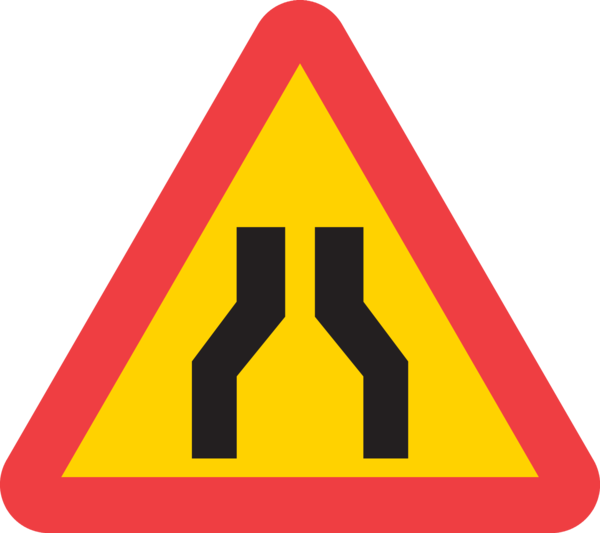
On a narrow road
If there is a cyclist ahead of you and a lorry coming towards you, and you would have to move into the opposite lane to keep a safe side distance, you slow down and stay behind. The lorry passing is not permission to overtake on its own. You reassess the view and the space.
What the law says
Vid färd på väg skall fordon föras i det körfält som är längst till höger i färdriktningen och som är avsett för fordonet.Unofficial translation: When driving on a road, a vehicle shall be driven in the lane that is furthest to the right in the direction of travel and that is intended for the vehicle.
3 kap. 7 § trafikförordningen
Try it yourself
2 questions from this lesson, no sign-in.
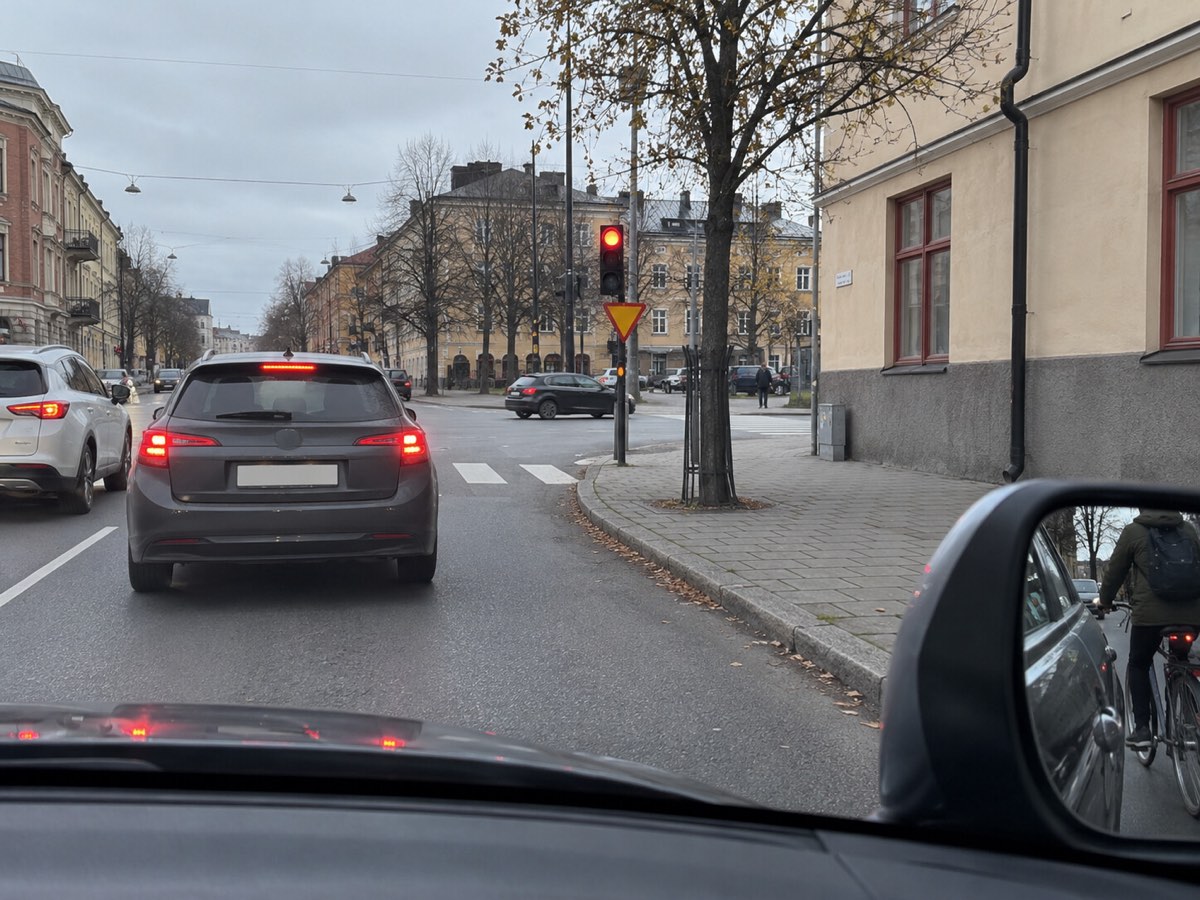
You are about to turn right at the junction. Which is true about the situation in the photo?
Cyclists may overtake vehicles other than cycles and mopeds on the right.
The gap draws the cyclist into the spot where your paths cross.
When turning right, keep as close to the right-hand edge of the carriageway as you reasonably can, so that no gap opens up. Cyclists may overtake cars on the right, and you may only turn if it is safe for traffic going the same way, so let the cyclist pass first.
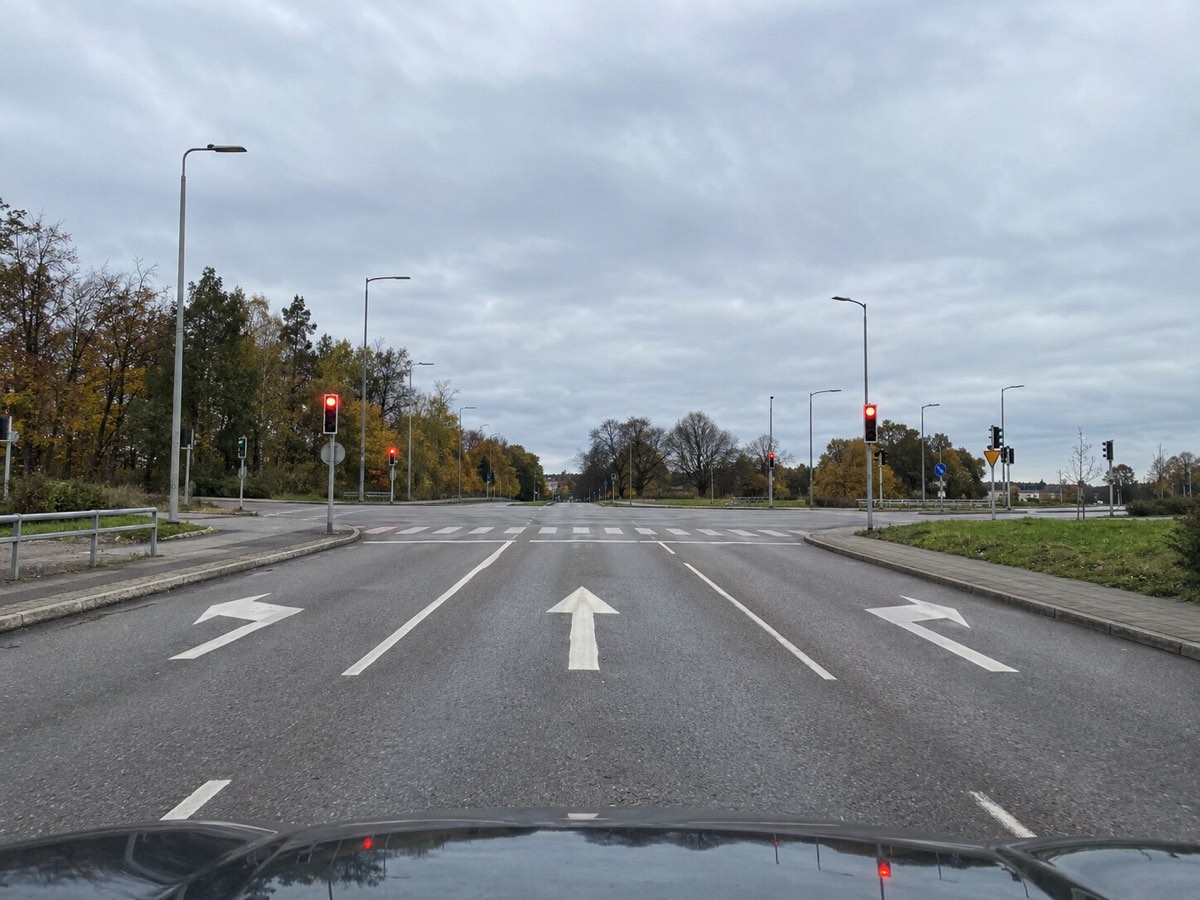
You are going to turn left at the junction in the photo. Which lane should you be in?
The middle lane's arrow shows straight ahead only; a driver turning left moves into the leftmost lane.
For a left turn the law sets the leftmost lane; at a solid line the arrow must also be followed.
Where the carriageway before a junction has several lanes in the same direction, a driver turning left must move into the leftmost lane in good time (TrF 3 kap. 25 §). Lane arrows show the suitable lane; if the lane is bounded by a solid line, the driver must follow the arrow (VMF 4 kap. 9 §, M19). In the photo the left lane has a left-turn arrow and is separated from the middle lane by a solid line. The straight-ahead arrow in the middle lane does not cover turning left; the arrows are not just recommendations either, and which lane is free does not decide it.
More questions on this topic are in the app.