
Giving way · 10/14
Trams and rail vehicles
2 min read
You leave a clear way for a tram or train and stop if necessary. It does not matter which direction it comes from.
The Swedish term for tram is .
Why?
A rail vehicle cannot leave the rails and needs a very long distance to stop. It has no way of avoiding you. That is why it is given priority. The reasoning for the priority given to a train at a level crossing is the same.
What does not change it?
- The tram coming from your left: the priority to the right rule does not override this priority.
- You being on a priority road.
- The horn: warning does not change priority.
- The number of passengers on the tram.
What does change it?
- A sign that puts an obligation to give way on the tram driver. A tram is not exempt from such a sign just because it runs on rails.
- A traffic light. If the light is red for the tram, priority changes.
- A police officer's instruction. It overrides the general rules and signs, and is not only for cars. If the officer tells the tram to stop and you to go, you go carefully. Even so, you do not take a risk by assuming only the tram will stop.
A tram standing at a stop
If you pass on the right of a tram or bus standing at a stop with no island, you stop and leave a clear way for the passengers getting off and on. Slowing down, dropping to walking pace or sounding the horn is not enough.
When crossing the rails
If there is a risk of being stuck on the rails, you do not enter, even if no tram is in sight. The assumption that you can back out when a tram comes does not hold. You confirm in advance that there is room to cross the rails completely.
What the law says
En trafikant skall lämna fri väg för 1. utryckningsfordon som avger signal med föreskriven larmanordning, och 2. järnvägståg eller spårvagn om inte spårvagnsföraren har väjningsplikt som utmärks genom vägmärke. Förare som skall lämna fri väg skall stanna om det är nödvändigt.Unofficial translation: A road user must leave a clear way for 1. an emergency vehicle that gives a signal with the prescribed alarm device, and 2. a railway train or tram, unless the tram driver has an obligation to give way that is marked by a road sign. A driver who must leave a clear way must stop if it is necessary.
2 kap. 5 § trafikförordningen
Try it yourself
2 questions from this lesson, no sign-in.
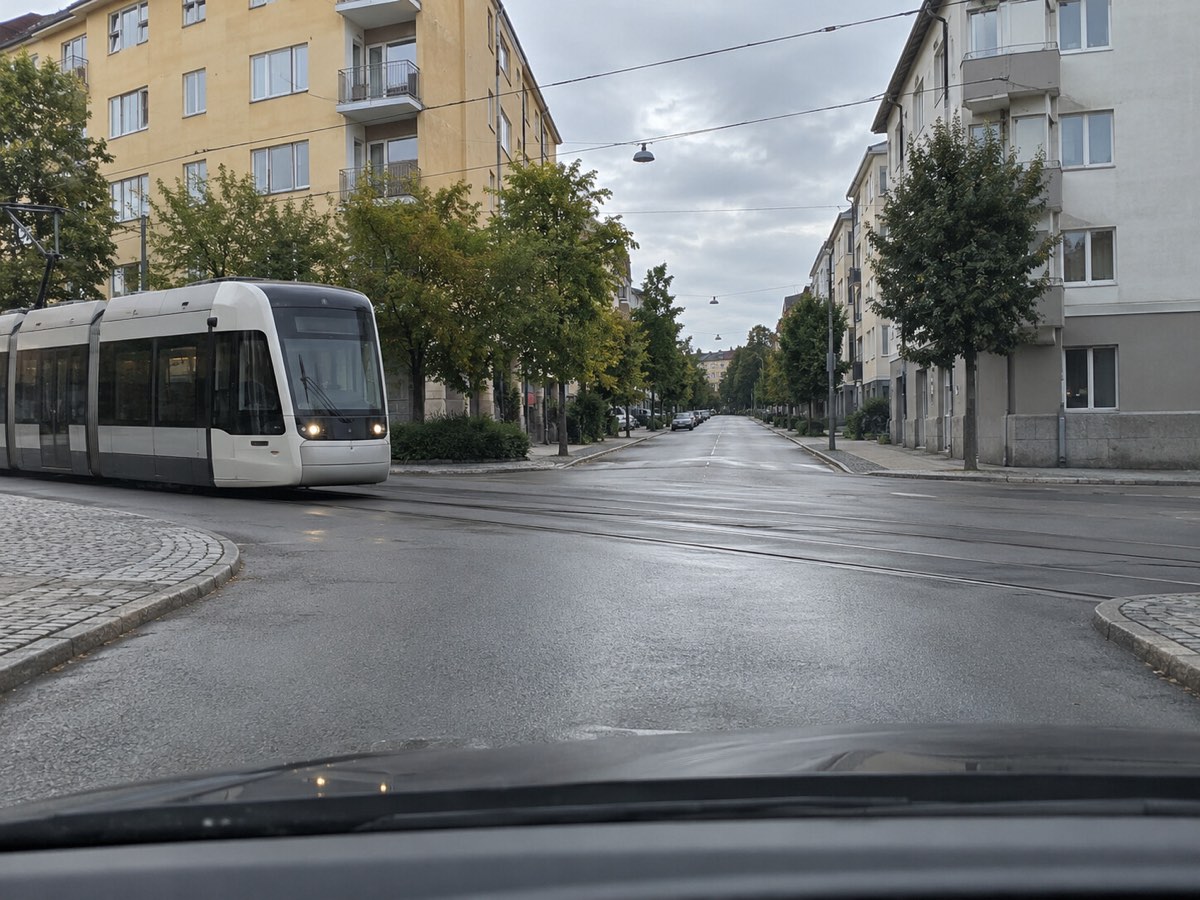
There are no signs or lights at the junction in the photo, and a tram is approaching from the left. What is the best course of action?
Priority to the right does not override the priority of a rail vehicle.
Warning it does not change priority; the tram cannot get out of the way anyway.
As a rule, rail vehicles have priority; the reason is that they cannot leave the rails and need a long distance to stop. Priority to the right does not apply here: even though the tram is coming from your left, you give way to it. Priority only changes if there is a red light or a give-way sign for the tram.
You are on a priority road and a tram’s path crosses yours. No sign requires the tram to give way and no other instruction applies. What do you do?
Free passage for a tram does not depend solely on its approaching side.
Priority-road status does not remove the free-passage duty here.
Give a tram free passage unless a valid exception, such as its signed give-way duty, applies; stop if necessary. Priority-road status does not remove this duty. Signals or police instructions apply separately and actual danger must not be ignored.
More questions on this topic are in the app.