
Giving way · 9/14
Give-way sign
2 min read
At a give-way sign you give way to those on the crossing road. If the road is clear, you can go through without stopping.
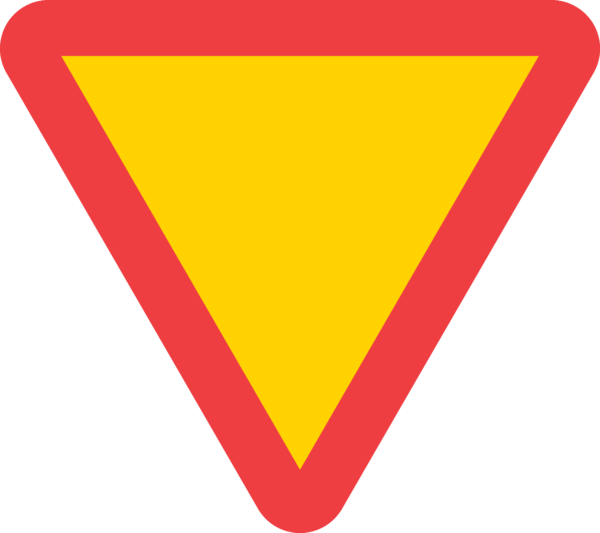
What does the sign require?
The sign does not give you priority, and it is not just a warning: it creates an obligation to give way. It requires a stop only if necessary. If the crossing road is clear, your view is open and you can join safely, you slow down and go through without stopping.
What does giving way mean?
It means not forcing those on the crossing road to change speed or direction. You stop if necessary to do that. Waiting for them to stop is not giving way. You show your intention by slowing down or stopping in good time.
Can you carry on?
The test is whether danger or obstruction will arise. The crossing road does not have to be completely empty: a vehicle far away does not automatically forbid you from going. If a vehicle is approaching and you would pull out in front of it, you wait for it to pass. Slowing down does not allow you to pull out in front of that vehicle.
The on the road shows the line you must not cross while giving way.
How it differs from a stop sign
| Subject | Give way | Stop |
|---|---|---|
| Obligation to give way | Yes | Yes |
| Full stop when the road is clear | No | Yes |
The only difference is the full stop. Stopping at a stop sign does not remove the obligation to give way: after you stop, you still give way.
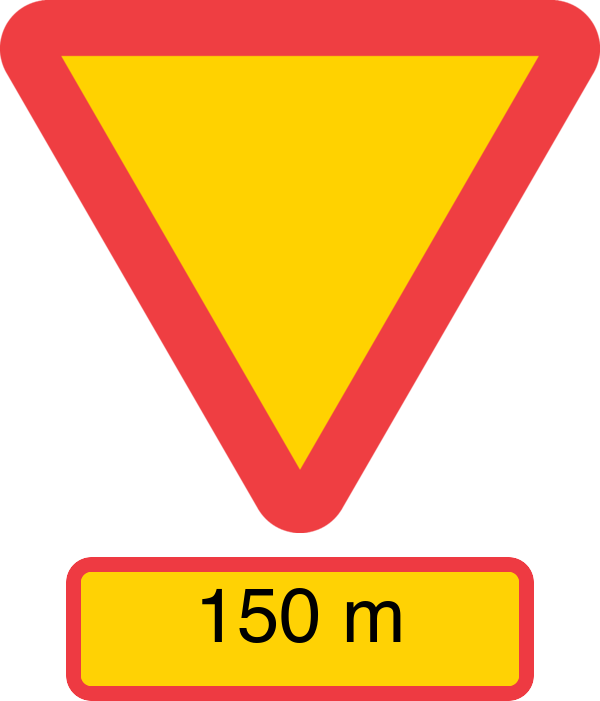
If there is a distance underneath
Common mix-ups
- There is no obligation to slow to walking pace.
- You give way by slowing down or stopping, not with a signal, a flash of the headlights or the horn.
- Whether you may go is decided by the give-way rule, not by whether you hear a horn.
- Under the same sign there may also be a separate additional panel giving the distance to an obligation to stop: it warns of the obligation to stop ahead.
What the law says
Förare som har väjningsplikt skall tydligt visa sin avsikt att väja genom att i god tid sänka hastigheten eller stanna. Föraren får köra vidare endast om det med beaktande av andra trafikanters placering, avståndet till dem och deras hastighet inte uppkommer fara eller hinder.Unofficial translation: A driver who has an obligation to give way must clearly show the intention to give way by slowing down in good time or stopping. The driver may drive on only if, taking into account the position of other road users, the distance to them and their speed, no danger or obstruction arises.
3 kap. 5 § trafikförordningen
Try it yourself
2 questions from this lesson, no sign-in.
What is the only difference between a give way sign and a stop sign?
A complete stop is required at the stop sign, not at the give way sign.
A complete stop does not replace the obligation to give way; the two apply together.
Both signs create the same obligation to give way; the only difference is that the stop sign (obligation to stop) also requires a complete stop. Stopping at a stop sign does not remove the obligation to give way: after stopping, you still give way to those on the crossing road.
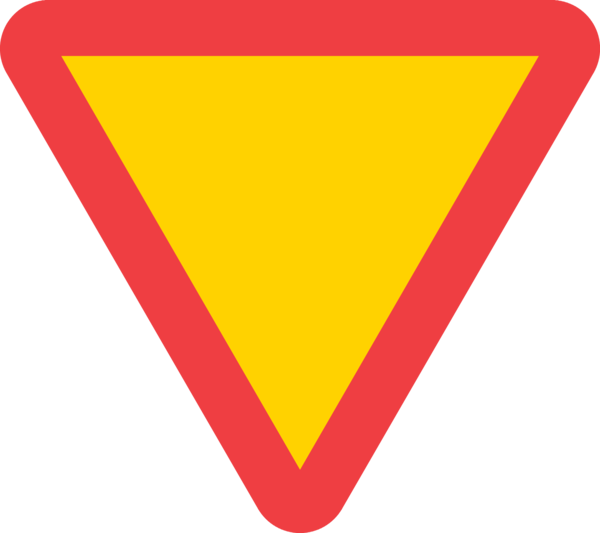
You are approaching a junction with the sign in the picture. The crossing road is empty and you can see clearly both ways. What applies?
A full stop is required at a stop sign (B2), not at a give-way sign.
Even when the road is empty you must slow down in good time.
Sign B1 means you must give way, and under 3 kap. 5 § trafikförordningen you show this by slowing down in good time or stopping. A full stop is required only at a stop sign, B2.
More questions on this topic are in the app.