
Giving way · 2/14
Roundabout
2 min read
When you enter a roundabout, you give way to every vehicle already in it. This includes cyclists.
The Swedish term for roundabout is .
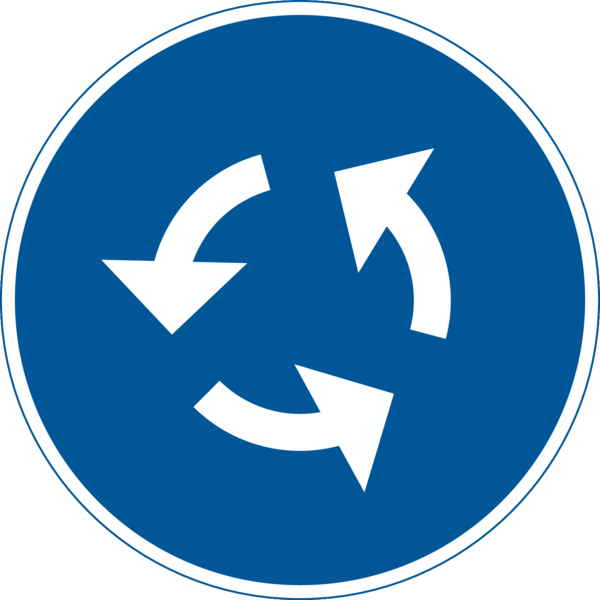
Entering
You move forward according to a safe gap that does not obstruct a vehicle already in the roundabout. You slow down or stop in good time. You do not need to wait for the roundabout to be completely empty. A vehicle in the roundabout should not have to brake for you.
- At the entry, the priority to the right rule does not apply. The entry rule does.
- Arriving first, or seeing the vehicle on your left, does not give you priority.
- Being a motor vehicle gives you no priority over a cyclist. The cyclist does not have to dismount and walk.
- The horn gives no priority.
Which lane?
In a roundabout with two lanes, you choose the lane that suits the road you are heading for, and follow any signs and markings. The inner lane is not required for a distant exit, and the outer lane is not forbidden.
When do you signal?
Signalling is not required for entering. If you change lane, the signal and safety requirements apply separately.
When you leave, you signal right in good time. If you take a later exit, you signal after passing the exit before yours. Signalling at the entry may make others think you will leave at the first exit. If you leave at the first exit, you signal as well: others must understand your intention in time. A signal given after you have left carries no information.
Leaving from the inner lane
Heading for an exit from the inner lane is a lane change, and you are the one changing. Being in the inner lane gives you no priority. Signalling does not earn you a right either. It makes no difference whether the vehicle in the outer lane signals: you cannot endanger it or obstruct it unnecessarily. If there is a vehicle beside you, you do not speed up to get in front. You wait for a safe gap and, if needed, go round once more.
If you are in the outer lane
If you notice that a driver in the inner lane wants to move into your lane, you adjust your speed so as to make it easier. This does not give them priority: if there is no safe gap, they wait.
What the law says
En förare som kör in i en cirkulationsplats har väjningsplikt mot varje fordon som befinner sig i cirkulationen.Unofficial translation: A driver who enters a roundabout must give way to every vehicle that is in the roundabout.
3 kap. 22 § trafikförordningen
Try it yourself
2 questions from this lesson, no sign-in.
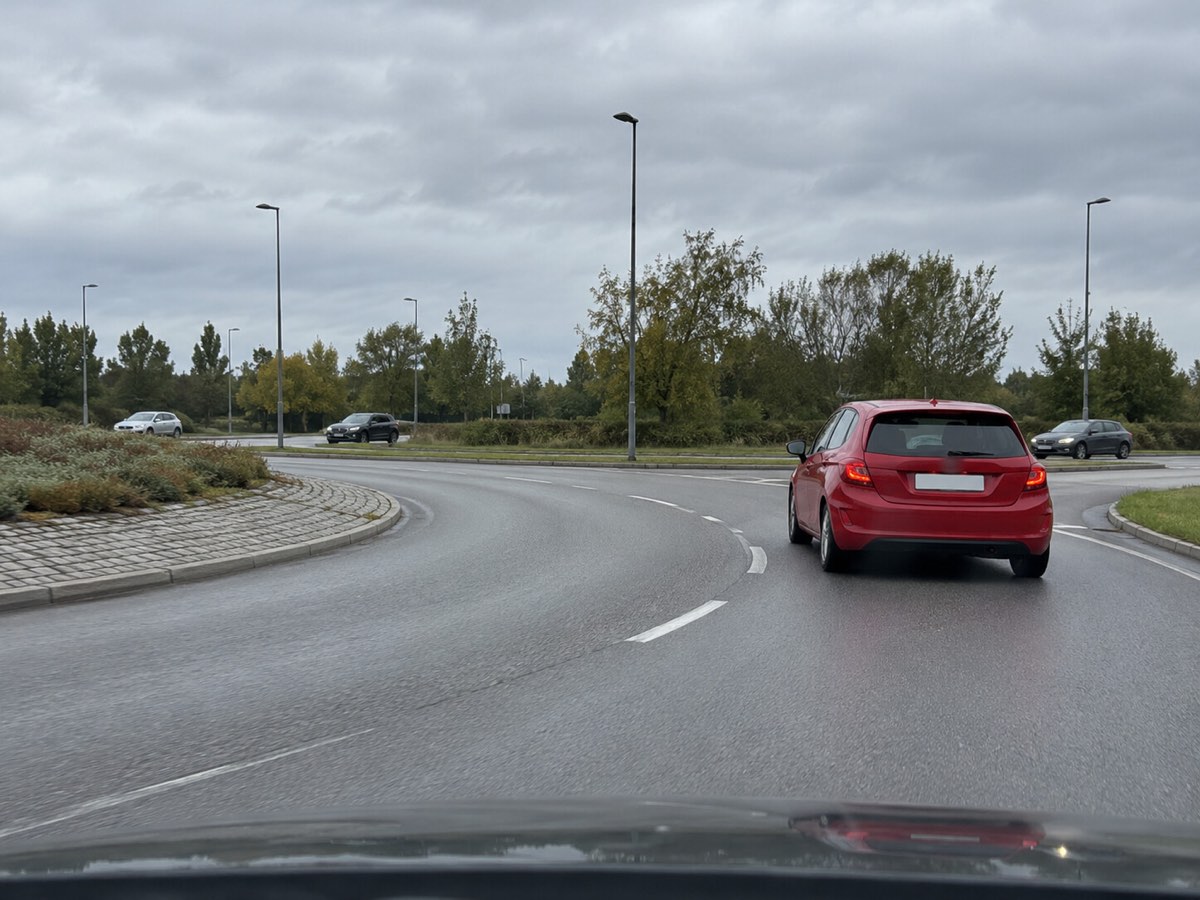
In the photo you are in the inner lane of the roundabout and will leave at the next exit on the right. What do you do?
The inner lane gives no priority; steering for the exit is a lane change and 3 kap. 43 § applies.
The rule does not depend on signals; you may not obstruct the car in the outer lane even if it is not signalling.
Steering for the exit from the inner lane of a roundabout is a lane change. You may change lanes only if it causes no danger or unnecessary obstruction to other road users (TrF 3 kap. 43 §); being in the inner lane gives no priority. Transportstyrelsen therefore advises paying extra attention to vehicles in the outer lane when leaving from the inner lane. Whether the car in the outer lane is signalling does not change the rule.
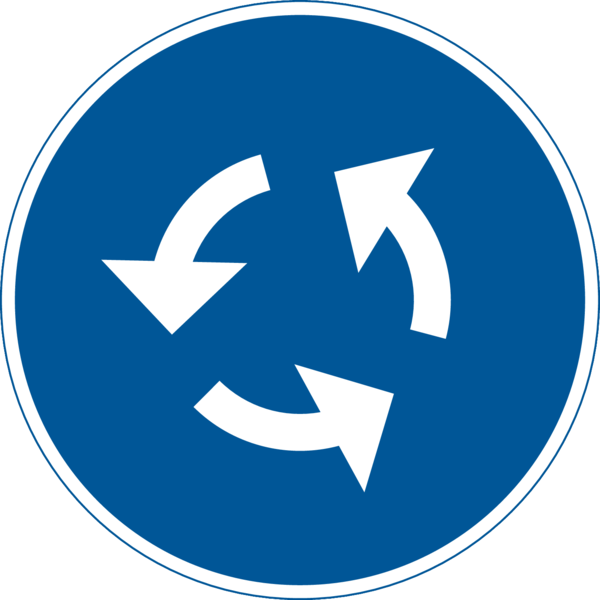
You are driving through the junction marked by the sign in the picture. Your passenger wants to get out as soon as possible. Which is correct?
The ban covers all stopping, including a quick drop-off.
Hazard warning lights do not make a stop legal where stopping is banned.
Sign D3 marks a roundabout, and under 3 kap. 53 § trafikförordningen you may neither stop nor park in a roundabout. That includes a brief stop to let someone out, so leave the roundabout and stop where it is allowed.
More questions on this topic are in the app.