
Giving way · 7/14
Priority road
2 min read
If you are on a priority road, traffic from side roads gives way to you at junctions. This priority ends at the sign marking the end of the priority road.
The Swedish term for priority road is .

What the sign does not give
- It does not raise the speed limit or allow parking.
- It does not put an obligation to stop or give way on you.
- It does not remove the duty to prevent danger. You adapt your speed to conditions and check that the other driver really is giving way.
Where does the priority road end?
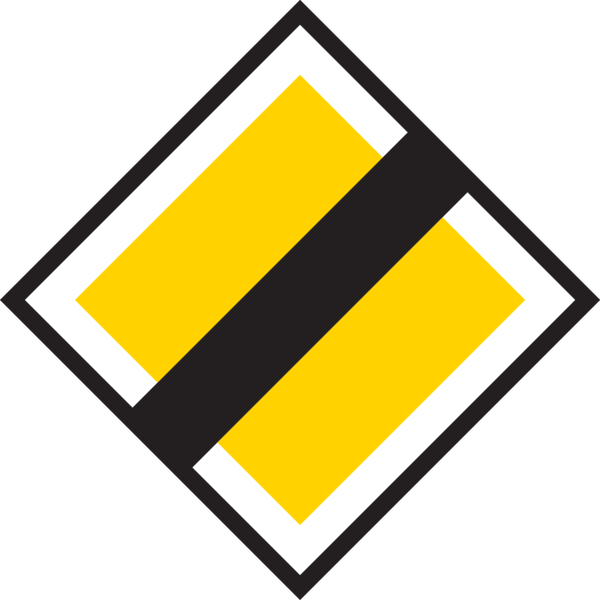
Entering a built-up area or the road changing direction at a junction does not end the priority road. B5 does not bring a full stop. It ends your priority. At the next ordinary junction, you give way to the right unless something else is arranged or the exit exception applies. The horn is no substitute.
If the priority road turns at a junction
The additional panel under B4 shows the course of the roads: the thick line is the priority road, the thin line is the road that gives way to it.
- If the side road has a give-way sign, the driver there gives way to you. This is so even if they are on your right and even if you go straight on and leave the priority road.
- Between two vehicles coming from the two arms of the priority road, this sign gives no priority. If their paths cross, you give way to the right.
- If the priority road turns right and you go straight on, you give way to a vehicle coming from the right arm and following the priority road. Going straight on or coming from the priority road gives no priority here.
- If you turn right to follow the priority road, you still signal in good time. The road being a priority road does not remove the signal.
Parking on a priority road
Parking on a priority road is forbidden, both inside and outside built-up areas. The edge of a built-up area alone gives no permission unless a separate rule allows it.
What the law says
En förare som från en väg kör in på en annan väg som är huvudled, motorväg eller motortrafikled och där accelerationsfält saknas, har väjningsplikt mot fordon på den väg föraren kör in på. Väjningsplikten gäller dock inte där föraren kommer in på huvudleden, motorvägen eller motortrafikleden utan att byta körfält.Unofficial translation: A driver who joins a priority road, motorway or road for motor vehicles from another road, where there is no acceleration lane, must give way to vehicles on the road the driver joins. The obligation to give way does not apply, however, where the driver joins the priority road, motorway or road for motor vehicles without changing lane.
3 kap. 21 § trafikförordningen
Try it yourself
1 questions from this lesson, no sign-in.
The priority road turns left at the junction and you are following it. A car on the priority road is coming from the left and going straight on. Your paths cross. Which is correct?
The car is not oncoming; it comes from your left, so priority to the right applies.
On the priority road, the vehicle on the right goes, not whoever arrives first.
A priority road gives you priority over traffic joining it from another road (3 kap. 21 § trafikförordningen). When both vehicles are on the priority road, priority to the right applies between them (3 kap. 18 §): you are on the other car's right, so it gives way to you even though you are turning left.
More questions on this topic are in the app.