
Giving way · 6/14
Giving way to the right
3 min read
If your path crosses another vehicle's and nothing else sets priority, you give way to the vehicle coming from the right.
Transportstyrelsen calls this rule . The Swedish term for the obligation to give way is .
When does the rule apply?
First look for a police officer's instruction. Then look at traffic lights, signs and road markings. These override this rule. If none of them sets priority, this rule applies.
How do you give way?
You show your intention early: you slow down in good time or stop. You look at the position, distance and speed of the other road users. You carry on only if no danger or obstruction will arise.
Common mix-ups
- Priority is decided by the right-hand rule; arriving at the junction first does not change that.
- Priority is decided by the right-hand rule; a wider road does not change that.
- At a T-junction, being on the road that ends gives you neither priority nor a separate obligation to give way. You still give way to the right.
- Priority is changed by priority signs; a warning sign does not do that.
- Giving way means slowing down or stopping. Giving way depends on your own speed; you do not leave it to the horn or to the vehicle on the right slowing down.
In a car park
If two vehicles' paths cross inside a car park, you give way to the vehicle on the right unless something else is arranged. It makes no difference that the car park is private. When you leave a car park onto a road, the exit rule applies instead: you give way to every vehicle whose path you cross.
When does the rule change?
- When you join a priority road, motorway or road for motor vehicles that has no acceleration lane, you give way to the vehicles on the road you join. If you join without changing lane, this obligation does not apply.
- When you join a road from a property, petrol station, path, field track, cycle track, pavement or open ground, you also give way to every vehicle whose path you cross.
- When you enter a roundabout, you give way to the vehicles already in it.
- In an acceleration lane, you adapt your speed to the traffic on the road.
These have their own lessons.
What the law says
När två fordons kurser skär varandra har förare väjningsplikt mot det fordon som närmar sig från höger utom i de fall som avses i 21-23 §§.Unofficial translation: When two vehicles' paths cross, a driver must give way to the vehicle approaching from the right, except in the cases referred to in 21-23 §§.
3 kap. 18 § trafikförordningen
Try it yourself
2 questions from this lesson, no sign-in.
You are driving along a street. A car is about to pull out of a car park on your right, into your path. There are no signs. Which is correct?
Priority to the right does not apply when leaving a car park.
The duty to give way when leaving applies without any signs.
A driver coming out onto a road from a car park must give way to every vehicle whose path crosses theirs (3 kap. 21 § trafikförordningen). This applies without any signs and overrides priority to the right (3 kap. 18 §), so the car gives way to you even though it is on your right.
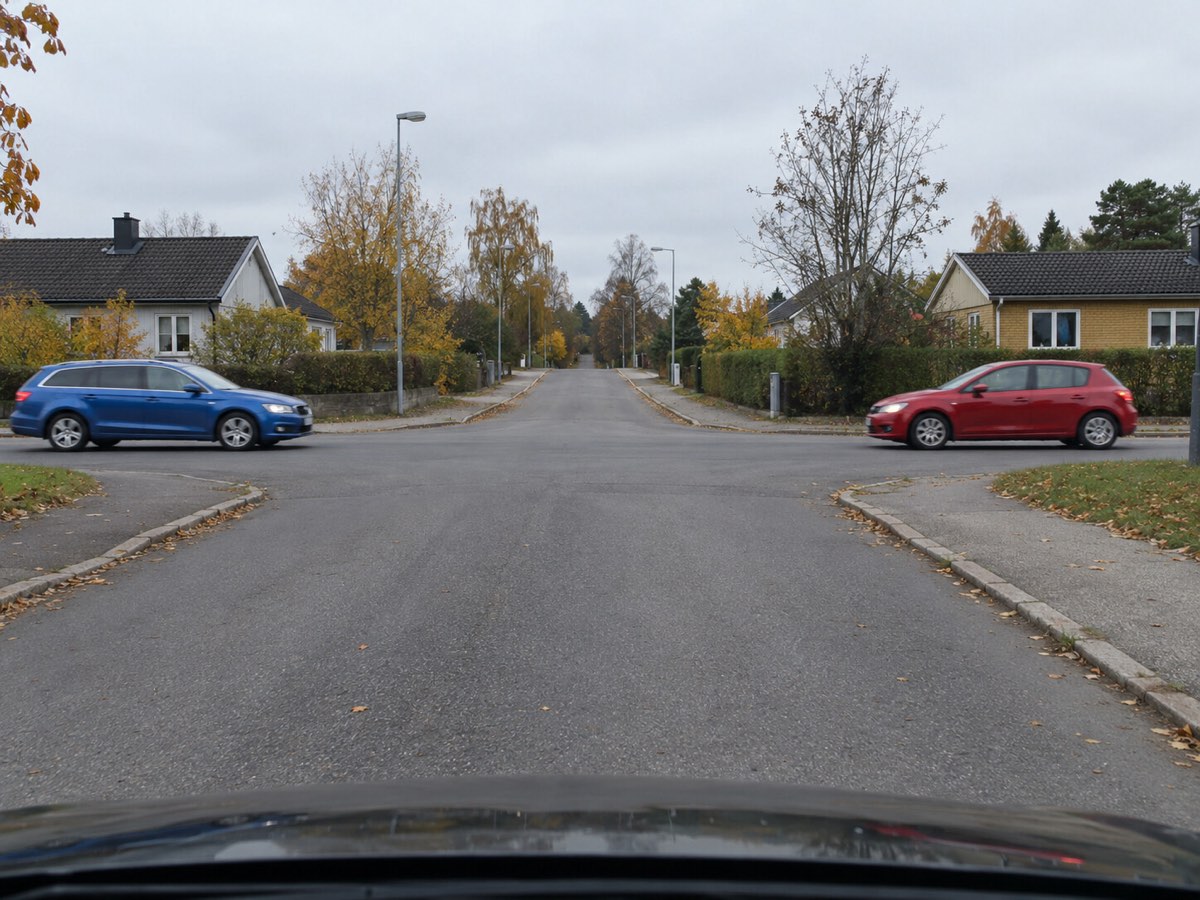
There are no signs at the junction in the photo, and all three vehicles are going straight on. What is the best course of action?
The vehicle on the left is on your left; you have no obligation to give way to it.
You do not need to give way to the one on the left; waiting for both vehicles locks the junction.
At a junction without signs you give way to traffic from the right. The vehicle on the right arm is on your right, and you are on the right of the vehicle on the left arm; so it is not you who gives way to it, but it that gives way to you. So you wait for the vehicle on the right first. Giving way to everyone stops the rule from working and locks the junction.
More questions on this topic are in the app.