
Giving way · 4/14
Giving way when changing lane
2 min read
You change lane only when you endanger no one and obstruct no one unnecessarily.
The Swedish term for lane is .
A signal gives you no right
A signal only shows your intention. It does not give you priority and does not share the responsibility. Even after you signal, you must make sure the manoeuvre is safe.
If there is no gap, you keep the signal on and wait for a suitable gap. Starting to move in slowly, angling towards the vehicle, going half a car length in, or speeding up to force your way in does not remove this duty. None of it passes the obligation to the other side.
What does the driver in that lane do?
A driver who notices that you want to move in also adjusts speed to make it easier. This does not give you a right to force your way in, and you cannot assume they will brake. Both duties apply together.
Check the real gap first
- You also check the area your mirrors do not show. Not seeing a vehicle in the mirror does not prove the space is empty.
- A convex mirror can make objects look smaller and further away than they are. The real gap may be shorter, so you check the safe distance separately.
When two lanes merge
When two lanes narrow to one, neither the driver on the right nor the one on the left has automatic priority. Drivers adapt to the new situation with mutual care. In practice vehicles go through one at a time in turn, which is called the zip merge. The same applies when two carriageways merge.
Your lane ending gives you no priority. If the vehicle beside you is slightly ahead, you defer to it and go in behind it. You do not speed up to get in front.
If every lane has dense queuing traffic
Only the driver in the rightmost lane may change lane. The others may change only to stop, to park, or to move into a suitable lane before a junction.
What the law says
En förare får starta från vägkanten, byta körfält eller på annat sätt ändra fordonets placering i sidled endast om det kan ske utan fara eller onödigt hinder för andra vägtrafikanter.Unofficial translation: A driver may start from the roadside, change lane or otherwise alter the vehicle's position sideways only if it can be done without danger or unnecessary obstruction to other road users.
3 kap. 43 § trafikförordningen
Try it yourself
2 questions from this lesson, no sign-in.
You are indicating to move into the left lane. If you move over now, the car just behind you in that lane will have to brake. What do you do?
That driver should help you merge, but you may not force them to brake.
You indicate when you intend to move over, before the gap is there.
Indicating only shows what you intend to do (3 kap. 65 § trafikförordningen); it gives you no right to make the other car brake (3 kap. 66 §). Move over only when you can do it without danger or unnecessary obstruction (3 kap. 43 §).
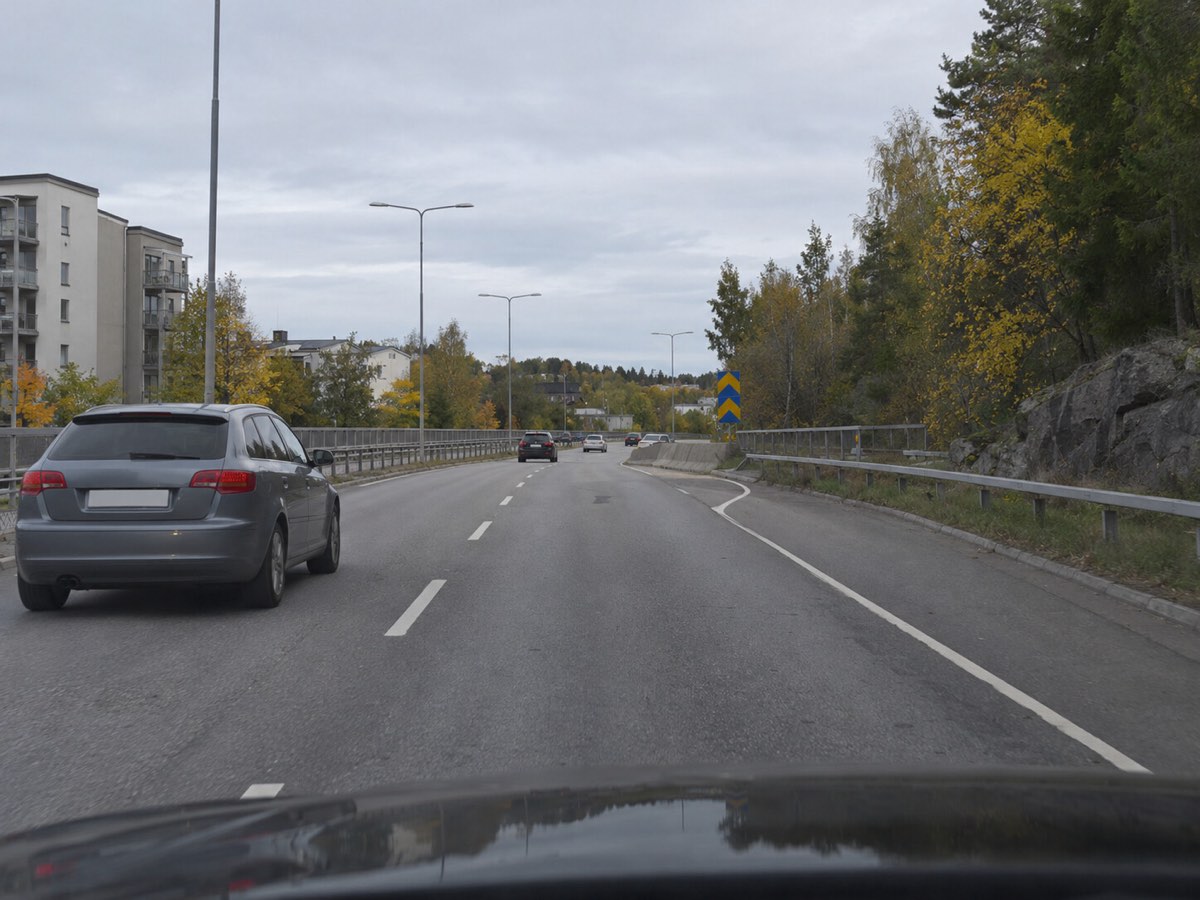
In the situation in the photo, your lane ends ahead. What is the best course of action?
Signalling shows your intention; it does not remove the obligation to give way.
Your lane ending does not create priority; drivers adjust to each other, and the driver changing lanes must not cause obstruction.
When two lanes merge, drivers adapt to the new situation with mutual consideration. A driver changing lanes may only do so without causing danger or unnecessary obstruction; the driver in the other lane also adjusts their speed to make it easier to move in. In the photo the vehicle on the left is slightly ahead, so the right thing is to adjust to it and move in behind it. Signalling shows your intention but does not remove the obligation to make sure the manoeuvre can be carried out safely.
More questions on this topic are in the app.