
Giving way · 12/14
Giving way when turning
2 min read
When you turn left, you do not obstruct oncoming traffic. After you turn, you also give way to pedestrians on the crossing you drive over and to cyclists on the cycle track.
Oncoming vehicle
An oncoming vehicle going straight on or turning right goes before you. Signalling or reaching the junction first gives you no priority. You also cannot obstruct traffic on the carriageway you will enter.
If the oncoming vehicle signals right but is still coming straight on, you do not trust the signal. A signal is only information about intention. You check the real movement and the gap, and you cannot use the horn to force it to turn.
Where do you wait at a junction with lights?
If the oncoming traffic does not stop, you enter the junction and wait near the turning point. You take your vehicle as close to the middle of the carriageway as you can, and position it so as not to obstruct the crossing road unnecessarily. When oncoming traffic stops on amber, you complete the turn, because amber tells vehicles that have not yet crossed the line and can stop safely to stop. If you wait behind the line, you cannot get through when the light changes. Waiting in the oncoming lane is forbidden.
When two oncoming vehicles both turn left
If there is no danger or disturbance, you can turn left in front of each other. The one who arrived first need not go first, and neither must always wait. This is not an automatic right at every junction: you check pedestrians, markings and other traffic.
After turning
- Pedestrian crossing with lights (): you approach at low speed. You give way to pedestrians who are on the crossing or about to step onto it, and stop before the crossing if necessary. Your own green does not remove this. You do not stop your vehicle on the crossing.
- Cycle track (): if your turn crosses this track, you let the cyclist there pass. Being the one turning, the horn or a signal gives you no priority. Cycle crossings have separate rules.
What the law says
En förare som skall svänga i en vägkorsning eller skall lämna eller korsa den körbana han eller hon färdas på skall förvissa sig om att det kan ske utan hinder för mötande trafik eller för trafikanterna på den körbana som föraren avser att köra in på.Unofficial translation: A driver who is to turn at a road junction, or to leave or cross the carriageway on which he or she is travelling, must make sure that it can be done without obstruction to oncoming traffic or to the road users on the carriageway the driver intends to enter.
3 kap. 24 § trafikförordningen
Try it yourself
2 questions from this lesson, no sign-in.
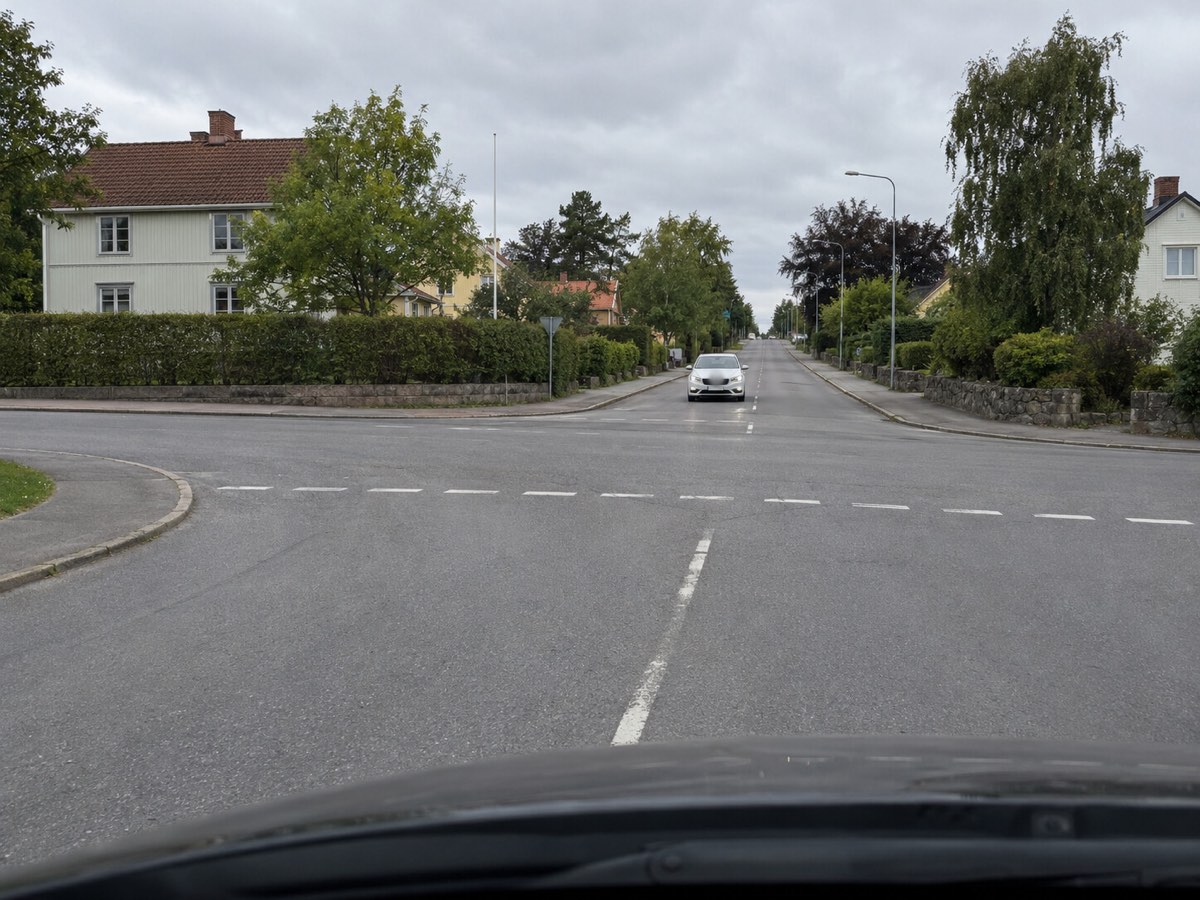
You are turning left at the junction in the photo. The oncoming vehicle is going straight on. Who goes first?
A signal only shows intention; it does not remove the turning driver's duty to give way.
Entering the junction first does not create priority; the duty to give way remains.
A driver turning left must make sure that the turn can be made without obstructing oncoming traffic going straight on or turning right (TrF 3 kap. 24 §). Signalling shows your intention, but does not remove the duty to make sure the manoeuvre can be made safely (3 kap. 66 §). Having entered the junction first does not give priority either.
You and an oncoming car are both turning left at the same junction. There is plenty of room and no other traffic. Which is correct?
You do not have to turn behind each other. Turning in front is allowed.
Arrival order does not decide who turns first here.
Under 3 kap. 27 § trafikförordningen, two vehicles coming from opposite directions that are both turning left at a junction may turn in front of each other if this causes no danger or inconvenience. There is no rule that whoever arrived first turns first.
More questions on this topic are in the app.