
Pedestrians and cyclists · 4/4
Pedestrian crossing
2 min read
At a not controlled by lights or police, you give way to a who is on the crossing or about to cross.
What does giving way mean?
The duty is yours. You do not wait for the pedestrian's first step or for them to step on the stripes. You adapt your speed in advance and, if needed, stop before the crossing. In rain and darkness, you slow down earlier. The fact that a vehicle behind you is close does not change this.
Reducing speed and passing in front of the pedestrian is not giving way. Neither is warning with the horn. The duty does not depend on the pedestrian's age or health. The pedestrian also takes the distance and speed of approaching vehicles into account, but this does not remove your duty.
If there is a vehicle in the next lane
Your stopping does not guarantee that the vehicle in the next lane will stop. You do not call the pedestrian forward or wave to give the impression that the whole road is safe. Your giving way secures only the movement of your own vehicle.
At a crossing with lights
- If a pedestrian has entered the crossing correctly on their own green, you let them finish crossing, even if you get a green light. The right does not end when the pedestrian's light changes.
- If a pedestrian stepped out on red, you have no duty to give way. Even so, you brake and stop if needed. A green light does not remove the duty to prevent an accident.
- If you pass a crossing with lights after turning at a junction, you drive slowly and give way to a pedestrian who has correctly entered or is about to enter.
You do not stop on the crossing
You drive so that you do not have to stop on the crossing. If there is a queue ahead and no room, you wait before the crossing. It makes no difference that there is no pedestrian at that moment, or that you plan to back out later. The same rule applies to a cycle passage and a cycle crossing.
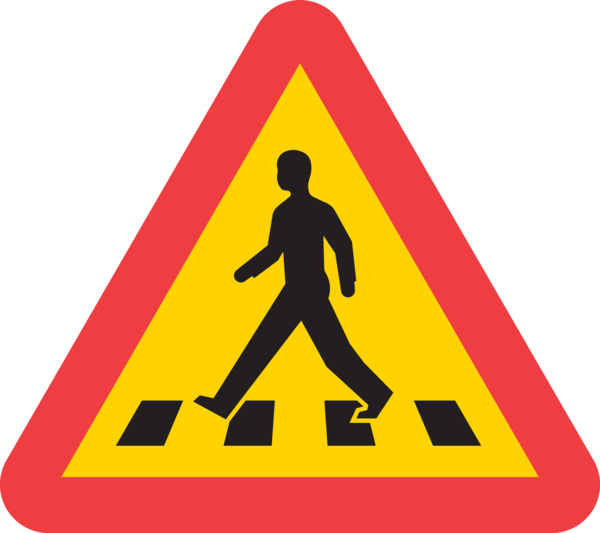
This warning does not create a pedestrian zone, a numerical speed limit or a ban on passing.
What the law says
Vid ett obevakat övergångsställe har en förare väjningsplikt mot gående som gått ut på eller just ska gå ut på övergångsstället.Unofficial translation: At an unattended pedestrian crossing, a driver has an obligation to give way to pedestrians who have stepped onto, or are just about to step onto, the pedestrian crossing.
3 kap. 61 § trafikförordningen
Try it yourself
2 questions from this lesson, no sign-in.
A pedestrian is just about to step onto an uncontrolled pedestrian crossing. There are two lanes in your direction, and the car in the lane beside you is not slowing down. What do you do?
You must give way even if the car beside you does not stop.
You must give way as soon as the pedestrian is about to step out.
At an uncontrolled pedestrian crossing you must give way to pedestrians who are on it or about to step onto it (3 kap. 61 § trafikförordningen). Each driver has this duty, so what the car beside you does makes no difference to yours.
At an uncontrolled pedestrian crossing, a pedestrian stands at the kerb looking at her phone. You cannot tell whether she will cross. What do you do?
Slowing a little is not enough if she steps out, and flashing will not stop her.
You must also give way to pedestrians who are about to step out.
Under 3 kap. 15 § trafikförordningen you must approach pedestrian crossings at a low enough speed, and under 61 § you must give way to pedestrians who are on the crossing or about to step onto it. When you cannot tell what she will do, you must be able to stop before the crossing.
More questions on this topic are in the app.