
Pedestrians and cyclists · 3/4
Cycle passage (cykelpassage)
2 min read
When driving straight on towards a without lights, you adapt your speed so that you do not endanger a cyclist on the passage. After turning, you drive slowly and give the cyclist a chance to cross.
When driving straight on
This is not the obligation to give way that applies at a cycle crossing. Here, the duty to give way belongs to the cyclist coming off the cycle track. But you cannot keep your speed. The cyclist's duty does not remove yours, and warning the cyclist does not replace adapting your speed. To avoid danger, you stop if needed. You drive so that you do not have to stop on the passage.
After turning
If you pass a cycle passage without lights after turning at a junction or leaving a roundabout, your duty changes. You drive slowly and give a cyclist or moped rider on the passage, or about to enter it, the chance to cross. You do not wait for the first wheel to reach the road.
What does the cyclist do?
The cyclist reduces speed, takes the approaching vehicle into account and crosses only if it is safe. Getting off and walking is not required. The driver's duty to adapt speed does not give the cyclist unconditional passage.
After an accident, both duties are examined: the driver's speed and the cyclist's safe entry. This does not automatically mean equal fault. The real circumstances of the event are considered.
How do you tell which one it is?
A cycle passage and a cycle crossing are marked with the same road marking. The difference is in the sign. If there is a B8 sign and a give-way line (triangles) at the crossing, it is a . A speed bump or a raised crossing is not a legal distinguishing feature. Nor is the cyclist's behaviour.
Sign A16
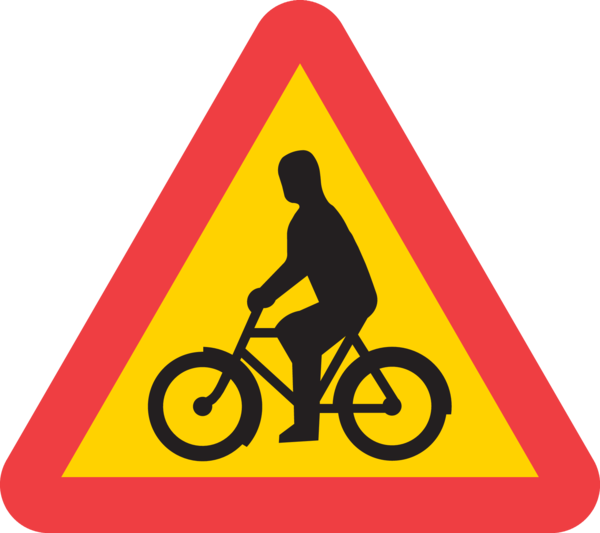
You adjust your speed and attention to the risk. The sign does not decide who gives way or set a speed figure. It is not an obligation to use a cycle track or a ban on entry.
What the law says
En förare som närmar sig en obevakad cykelpassage ska anpassa hastigheten så att det inte uppstår fara för cyklande och mopedförare som är ute på cykelpassagen.Unofficial translation: A driver approaching an unattended cycle passage shall adapt the speed so that no danger arises for cyclists and moped riders who are on the cycle passage.
3 kap. 61 § trafikförordningen
Try it yourself
2 questions from this lesson, no sign-in.
You turn right at a junction and immediately afterwards come to an uncontrolled cycle passage (cykelpassage). A cyclist is just about to ride onto it. What do you do?
After a turn you must give the cyclist the chance to cross.
After a turn the rule also covers a cyclist about to ride onto the passage.
After turning at a junction you must drive slowly and give cyclists the chance to cross if they are on an uncontrolled cycle passage or about to ride onto it (3 kap. 61 § tredje stycket trafikförordningen). Adjusting your speed is enough only when you go straight on. Even then, the rule covers only cyclists who are already on the passage.
You are cycling and about to cross the road at an uncontrolled cycle passage. A car is coming straight along the road. Which is correct?
Drivers give way at a cycle crossing, not at a cycle passage.
There is no rule that you must walk your bike across a cycle passage.
At a cycle passage the car does not have to give way, so slow down, watch for approaching vehicles and cross only if it can be done without danger (6 kap. 6 § trafikförordningen). Drivers give way at a cycle crossing, and you do not have to get off your bike.
More questions on this topic are in the app.