
Pedestrians and cyclists · 2/4
Cycle crossing (cykelöverfart)
2 min read
At a , you give way to a cyclist and a class II moped rider who are on the crossing or about to enter it.
What does giving way mean?
You do not wait for the first wheel to reach the carriageway. If the cyclist is about to enter, you stop before the crossing if needed and let them cross. Slowing down and then passing first is not giving way. You do not have to stop unconditionally at every empty crossing.
How is it defined?
A cycle crossing is defined by a local traffic decision, the road marking and the sign together. The sign is B8, and the marking is used together with a . The surroundings are designed so that vehicles are not driven faster than 30 km/h.
A speed bump helps with this but does not decide the type of crossing, and neither does red surfacing. A speed bump does not change the duties of the parties and does not turn the crossing into a cycle passage. The design does not make high speed physically impossible, and it does not put a signed limit on the approach road.
What does the cyclist do?
When entering the crossing, the cyclist takes the distance and speed of approaching vehicles into account. Your duty to give way does not remove this duty. Even so, the two sides do not have the same duty to give way.
How it differs from a cycle passage
| When driving straight on | Cycle crossing | Cycle passage without lights ([[cykelpassage]]) |
|---|---|---|
| Driver | Gives way | Adapts speed so that people on the passage are not endangered |
| Cyclist | Takes the distance and speed of vehicles into account | Slows down and crosses only if it is safe; the duty to give way is theirs |
The rules after a turn and at crossings with lights are separate.
Sign D7
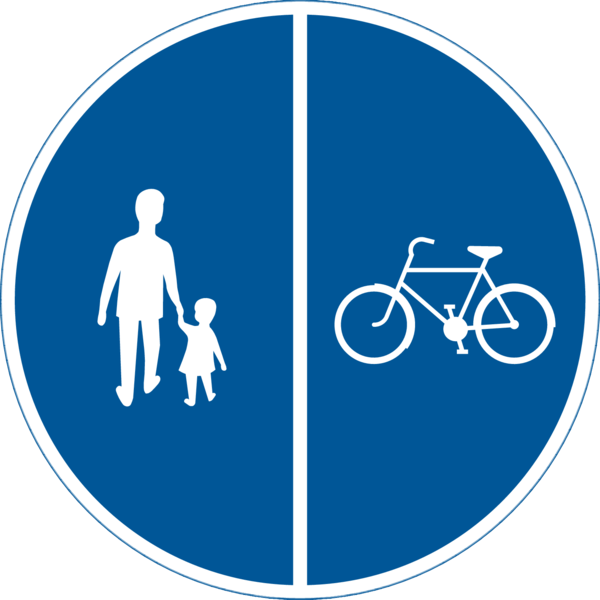
D6 indicates a shared path. D7 does not decide priority on the crossing carriageway or the type of cycle crossing.
What the law says
Vid en cykelöverfart har en förare väjningsplikt mot cyklande och förare av moped klass II som är ute på eller just ska färdas ut på cykelöverfarten.Unofficial translation: At a cycle crossing, a driver has an obligation to give way to cyclists and drivers of class II mopeds who are on, or are just about to enter, the cycle crossing.
3 kap. 61 a § trafikförordningen
Try it yourself
2 questions from this lesson, no sign-in.
Which is correct for a cyclist about to ride onto a cycle crossing (cykelöverfart)?
The cyclist may ride across; there is no need to get off.
Slowing down and crossing only if safe is the cycle passage rule.
At a cycle crossing, drivers must give way to cyclists who are on it or about to ride onto it (3 kap. 61 a § trafikförordningen). The cyclist must still consider the distance and speed of approaching vehicles (6 kap. 6 § andra stycket). Slowing down and crossing only if it is safe is the rule at a cycle passage (cykelpassage), not at a cycle crossing (6 kap. 6 § första stycket).
A hump is installed on the carriageway approaching a cykelöverfart. What is its main purpose for motor traffic?
The hump does not alter the parties’ legal duties in that way.
The hump alone does not convert an överfart to a passage.
A cykelöverfart must have a traffic environment designed to ensure vehicles are not driven above 30 km/h. A hump can reduce speed but does not alone establish the crossing type. It does not make higher speed physically impossible or impose a separate signed limit on the whole approach road.
More questions on this topic are in the app.