
Motorway · 2/4
Motorway and road for motor vehicles
2 min read
On a motorway () and a road for motor vehicles () it is prohibited to reverse, to turn (U-turn) and to stop anywhere except at a parking or rest place. No separate sign is needed.
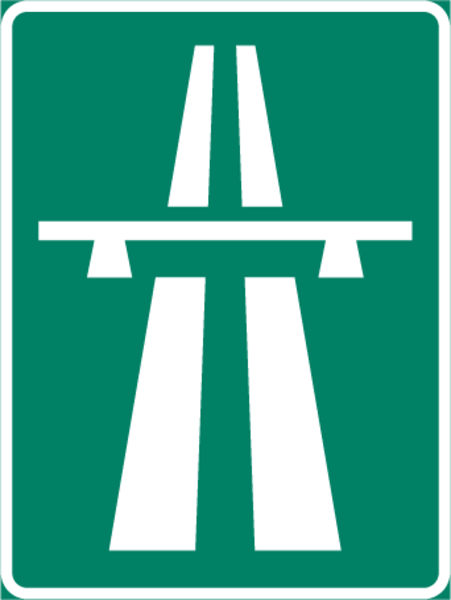
How do the two roads differ?
| Topic | Motorway | Road for motor vehicles |
|---|---|---|
| Directions | Separated by a barrier or central reservation | This is not required |
| Lanes | At least two in each direction | May be single-lane and two-way |
| Entry prohibitions | Apply | The same apply |
A picture does not decide the legal type of a road. A barrier or the number of lanes does not make a road a motorway by itself. The type is set by the local traffic regulation and the sign. You also cannot work out the speed limit from a picture.
Who may not enter?
- Pedestrians and cyclists. They cannot even walk along the edge.
- Mopeds. Even if a class I moped is built for 45 km/h, it is prohibited as well.
- Vehicles that are not built for at least 40 km/h or are not allowed to be driven at that speed.
A vehicle pulling a trailer may enter if it meets this condition. The condition is not an obligation to drive at least 40 km/h at all times: traffic and safety may call for a lower speed.
What is prohibited?
- Turning the vehicle round or reversing.
- Stopping or parking anywhere without a parking or rest place sign. The hard shoulder () is not one of these places. Scheduled buses may stop at their own special stops.
- Driving onto the dividing strip or onto the link between the carriageways.
If you miss your exit
You carry on to the next exit and correct your route from there. Even if the next exit is far away or the hard shoulder is wide, you do not reverse and you do not cross to the opposite carriageway.
Overtaking and exits
When you finish overtaking, you move back to the right-hand lane as soon as you can without danger or inconvenience. Driving at the speed limit or having no vehicle behind you is not a reason to stay in the left-hand lane.
When leaving, you lower your speed after you have entered the exit lane. Slowing down in the main lane obstructs those behind. Saving your braking until the end of the slip road also means not using the lane set aside for slowing down.
What the law says
Fordon får inte stannas eller parkeras annat än på platser som utmärkts med ett vägmärke som parkerings- eller rastplats.Unofficial translation: Vehicles may not be stopped or parked other than at places marked with a road sign as a parking place or rest place.
9 kap. 1 § trafikförordningen
Try it yourself
2 questions from this lesson, no sign-in.
You are on the motorway and realise you have just missed your exit. What do you do?
Reversing on a motorway is banned, hazard lights or not.
On a motorway you may only stop at a signed parking place or rest area.
On a motorway you must not reverse or turn round, and you may only stop where a sign marks a parking place or rest area (9 kap. 1 § trafikförordningen). Carry on and leave at the next exit.
Most motorway rules also apply on a road for motor vehicles (motortrafikled). Which rule applies only on a motorway?
The ban on stopping applies on roads for motor vehicles too.
The 40 km/h requirement applies on roads for motor vehicles too.
Under 9 kap. 2 § trafikförordningen, points 1–5 of the motorway rules also apply on a road for motor vehicles, but point 6, the 110 km/h limit, does not. So outside a built-up area such a road has the basic speed limit of 70 km/h unless another limit is signed (3 kap. 17 §).
More questions on this topic are in the app.