
Motorway · 3/4
Breakdown on a motorway
2 min read
If you break down on a motorway, you warn traffic, get away from the road and call for help. You make sure the vehicle is moved to a suitable place as soon as possible.
What do you do, in order?
- You get the vehicle to the safest place you can.
- You switch on the hazard warning lights () and put out the warning triangle (). Hazard lights do not take the place of the triangle.
- You move away from the vehicle and the road, and go behind the barrier if there is one.
- You call professional help. If there is danger to life, you call 112.
Where do you put the triangle?
Far enough away to warn approaching drivers in time. The law gives no fixed number of metres. The measure is not closeness to the vehicle or the triangle being in the vehicle's shadow. Right behind the vehicle may not be enough: if the vehicle is just beyond a bend, you take the limited visibility into account.
When you put out the triangle, you also protect yourself. If there is a barrier, you walk outside it.
Where do you wait?
Behind the barrier, away from the road, if you can get there safely. The hard shoulder () and the inside of the vehicle are where the risk of being hit from behind is highest. Right in front of or beside the vehicle does not protect you either. Being visible or signalling to approaching traffic by hand does not change this. A barrier does not remove every risk, so you choose a safe waiting point.
What applies to the vehicle?
The hard shoulder is not a rest area. It is prohibited to stop there to take a break, talk on the phone, or let passengers on or off. It being daytime or brief does not change this.
There is a separate rule for a vehicle left standing after a breakdown or accident: you make sure it is moved to a suitable place as soon as possible. The rule also covers engine failure and is not specific to accidents. Switching on the hazard lights does not remove this obligation. It does not mean you push the vehicle in a dangerous way: you arrange safe professional help. If there has been a death or serious injury in the accident, the vehicle is moved only if it is dangerous to other traffic.
What the law says
När ett fordon på grund av olyckshändelse, motorfel eller liknande orsak blivit stående på en plats där det enligt 47-49, 52-55 §, 9 kap. 1 eller 2 § eller lokal trafikföreskrift inte får stannas eller parkeras, skall föraren se till att fordonet snarast flyttas till en lämplig plats, om inte annat följer av bestämmelsen i 2 kap. 8 § om åligganden vid trafikolyckor.Unofficial translation: When a vehicle has been left standing, because of an accident, engine failure or a similar cause, at a place where under sections 47-49, 52-55, chapter 9 section 1 or 2, or a local traffic regulation it may not be stopped or parked, the driver shall see to it that the vehicle is moved to a suitable place as soon as possible, unless otherwise follows from the provision in chapter 2 section 8 on duties in road accidents.
3 kap. 51 § trafikförordningen
Try it yourself
2 questions from this lesson, no sign-in.
Your car has broken down on the motorway hard shoulder. The hazard lights are on and the car carries a warning triangle. What is true about the triangle?
Hazard lights do not replace the triangle required in this situation.
A position immediately behind the car may warn approaching drivers too late.
In this breakdown situation the warning triangle must be put out. Hazard lights do not replace that duty. Choose its position to warn other drivers in good time; the legal provision does not give a fixed number of metres. Avoid exposing yourself to traffic danger when placing it.
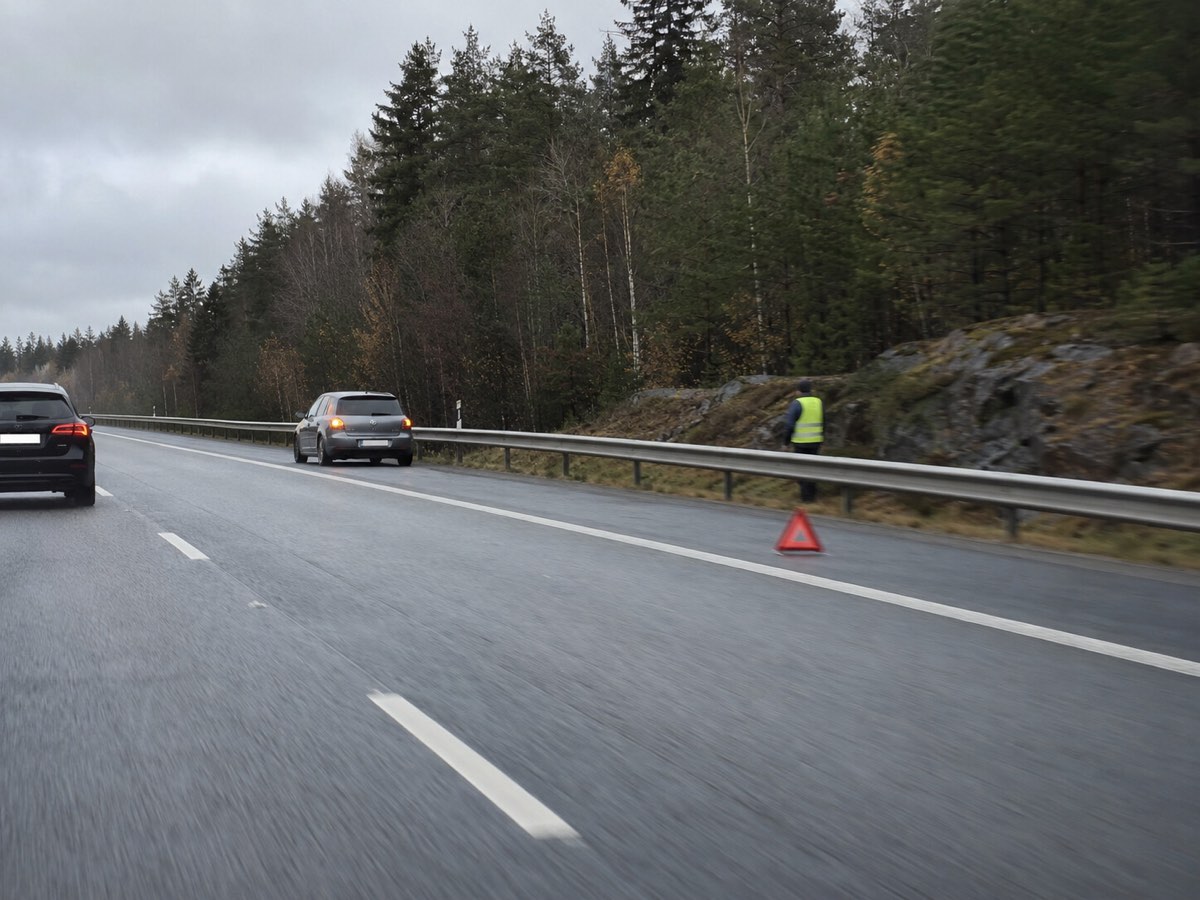
The photo shows what has been done for a vehicle that has broken down on a motorway. What applies to this arrangement?
The person is beyond the barrier; that is not what is missing in the photo.
The triangle is well behind the vehicle; that is not what is missing in the photo.
When a vehicle has stopped on a motorway, two things are done together: the warning triangle is placed far enough back for an approaching driver to be able to react, and the occupants move away from the carriageway to beyond the barrier. In the photo both have been done. Staying on the hard shoulder or in the vehicle means waiting where the risk of a rear-end collision is greatest.
More questions on this topic are in the app.