
Loads and towing · 2/7
Vehicle and load dimension limits
2 min read
With its load, a car may be at most 2.6 metres wide, and the load may not stick out more than 20 cm on either side. These two conditions are met separately.
A vehicle that exceeds these limits may be used only on a private road (enskild väg). Width is measured from the point that sticks out furthest, whether vehicle or load. For a bus the limit is 255 cm. There are separate provisions for farm implements, unbaled hay loads, tractors, work machines and indivisible loads.
If boxes stick out 25 cm on one side, the loading is not acceptable even if the total width is 2.4 metres. Putting up a marker does not give you permission to exceed this limit.
Which measurement do you look at on the sign?
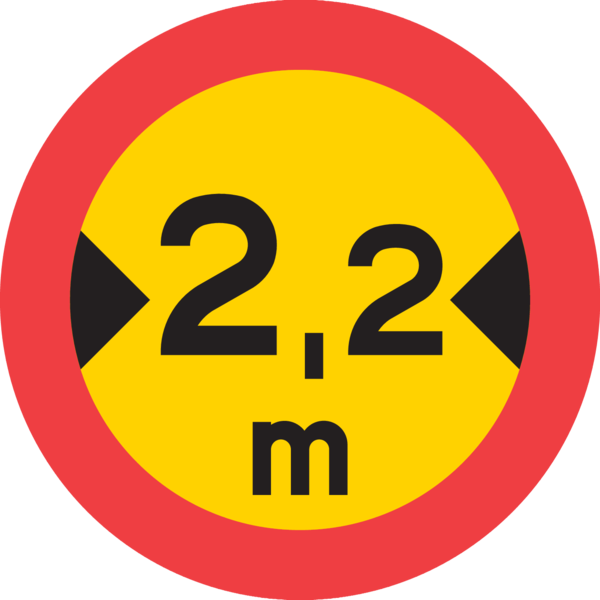
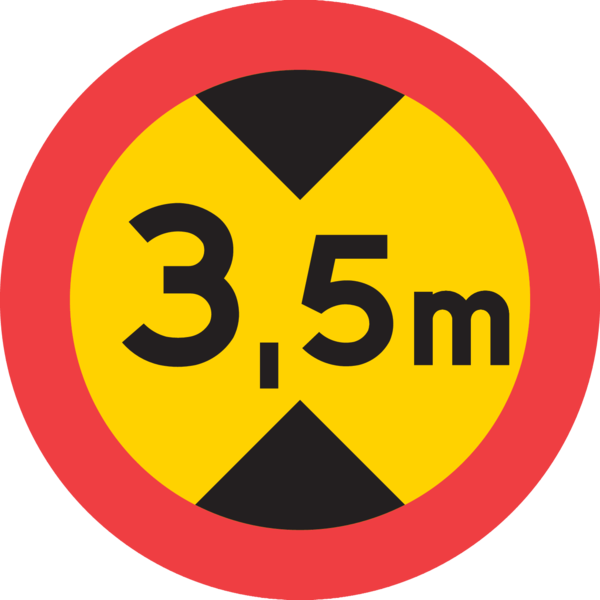
C18 is for length: from the foremost to the rearmost point, including the load.
If the load covers a light or the number plate
A load may not cover the required brake, indicator and lighting signals. Number plates must be legible. A short trip or daylight does not change this. Hazard warning lights () do not replace a covered lamp or plate. A legible front plate does not make up for the rear plate. You rearrange the load, make the lights visible and make the plate legible.
If a bicycle carrier covers the rear plate and the lights, you meet two requirements together: suitable rear lighting and a legible additional plate issued officially by Transportstyrelsen. One does not replace the other.
Overhang at the front and rear
A load that sticks out at the front must, as a rule, be marked. The visibility exception applies only to a load that sticks out less than one metre at the front; exactly 1 metre does not qualify. At the rear the threshold is more than one metre. These have a lesson of their own.
What the law says
Ett fordons bredd mäts över de delar av fordonet eller lasten som skjuter ut längst.Unofficial translation: The width of a vehicle is measured across the parts of the vehicle or the load that stick out furthest.
4 kap. 16 § trafikförordningen
Try it yourself
2 questions from this lesson, no sign-in.
Planks on the roof rack stick out 1.5 m behind the car. You are about to drive in the dark. What is required at the rear end of the load?
A flag cannot be seen in the dark; you need a lamp and reflectors.
A load sticking out over a metre must be marked regardless.
A load sticking out more than one metre behind the car must be marked (3 kap. 82 § trafikförordningen). In the dark, its rear end needs a lamp showing red light backwards and red reflectors placed low enough to catch other vehicles' dipped headlights.
How wide may a car with its load be on roads other than private ones, and how is the width measured?
Width is measured across the parts of the vehicle or load that stick out furthest; the load counts.
255 cm is the limit for a bus; for a car it is 260 cm.
A vehicle whose width including its load exceeds 260 cm (255 cm for a bus), or whose load sticks out more than 20 cm on either side, may be driven only on a private road; the width is measured across the parts of the vehicle or load that stick out furthest (TrF 4 kap. 15–16 §§). Separate provisions apply to, among others, farm implements, loose hay, tractors and motor implements, and to indivisible loads.
More questions on this topic are in the app.