
Stopping and parking · 5/6
Stopping and parking bans
2 min read
At some places both stopping and parking are forbidden, and at others only parking. These rules need no sign.
Both stopping and parking are forbidden
- On a hill crest or a bend with a blocked view, and close to them. Stopping briefly to write a message is not allowed either, and hazard lights do not change this.
- Along a separating lanes, if less than 3 metres remains between the vehicle and the line. 2.7 metres is not enough either. This ban does not apply if there is a between. You measure to the line, not to the opposite kerb.
- On a . You cannot park a car on the pavement. Room being left for pedestrians, or the street being narrow, does not create permission.
- At a . Without a boundary line, the ban covers 20 metres before and 5 metres after the E22 stop sign. The exception is actually letting passengers on or off without obstructing bus traffic. One minute for shopping is not that.
Only parking is forbidden
- On a , unless a special rule allows it. Even if the hard shoulder is wide, and even if no prohibition sign is visible.
- In front of a property entrance on the road. Even if it is your own garage. Staying in the vehicle with the engine running does not make parking something other than parking.
- Closer than 30 metres to a level crossing. This applies on both sides of the crossing, with or without barriers.
Sign C39
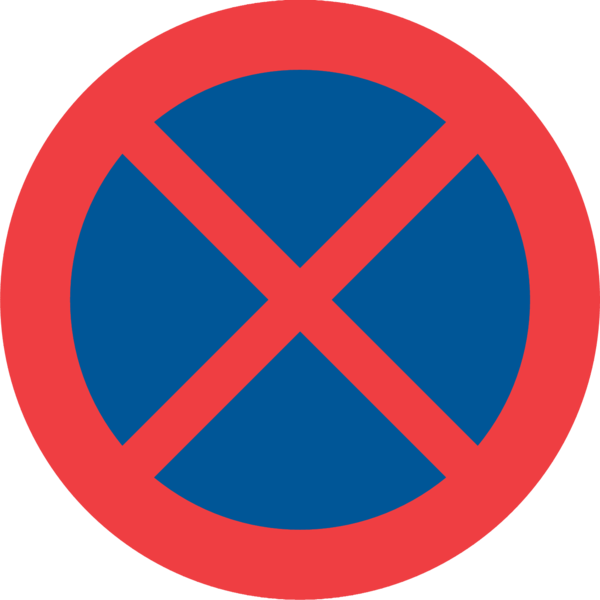
Stopping briefly to let a passenger out is also forbidden, even if you stay in the vehicle. The sign that forbids only parking is C35. A stop required by traffic or made to avoid danger is outside this ban.
Complying with one rule does not automatically satisfy the others: leaving 3 metres does not show that the place is free of other bans. Hazard lights do not remove these bans either.
What the law says
Ett fordon får inte parkeras 1. på en väg inom ett avstånd av trettio meter från en plankorsning, 2. på en väg framför infarten till en fastighet eller så att fordonstrafik till eller från fastigheten väsentligen försvåras, 3. på en huvudled,Unofficial translation: A vehicle may not be parked 1. on a road within a distance of thirty metres from a level crossing, 2. on a road in front of the entrance to a property or so that vehicle traffic to or from the property is significantly hindered, 3. on a priority road,
3 kap. 55 § första stycket 1-3 trafikförordningen
Try it yourself
2 questions from this lesson, no sign-in.
You are dropping off a passenger and will only stop briefly. Where are you allowed to stop?
You may not even stop in the ten metres before a pedestrian crossing.
Hazard warning lights do not lift the ban on stopping on the bend.
Within 30 metres of a level crossing, only parking is banned, so you may stop there to let someone out. In the ten metres before a pedestrian crossing and on a blind bend, you may neither stop nor park, and hazard warning lights do not change that.
You want to stop at the side of the road. There would be 2.5 m between your car and a solid line dividing the lanes, with no broken line in between. What applies?
The ban covers both stopping and parking.
The limit is 3 m, not 2 m.
You may not stop or park next to a solid line dividing the lanes if there would be less than 3 m between your vehicle and the line, unless there is a broken line in between (3 kap. 53 § trafikförordningen). Here there is only 2.5 m.
More questions on this topic are in the app.