
Road and visibility conditions · 2/6
Slippery surface
3 min read
On a slippery surface, grip is limited. You reduce your speed in advance, and you do not demand braking and steering at the same time.
Where does ice form early?
Bridges and viaducts lose heat in every direction because air passes beneath them too. In autumn they cool faster than the surrounding road and ice up early. The surface can freeze even when the air is slightly above zero. Stretches near open water can also cool quickly. The inside of a tunnel is protected from precipitation and the open air.
How do you share grip?
Grip is a single budget. Braking, accelerating and changing direction share the same budget. The share you give to braking reduces what is left for turning. If you turn the steering wheel while braking hard, the car keeps going straight.
You brake first and reduce speed, then you steer. You do not leave slowing down until you are in the bend: you brake before the bend. This is the same on a wet road with leaves. Giving up braking altogether is not right either: on a slippery surface too, braking reduces speed.
How far do you trust what you see?
- Conditions vary from stretch to stretch. Even after you have slowed down, you assess visibility, grip and traffic again.
- A different or shiny surface is not proof of grip. It may be water, frost or ice. You adapt your speed without diagnosing it, and you avoid sudden movements.
- If rain starts after a long dry spell, you take the uncertainty of the grip into account and adapt your speed. You do not assume the rain will clean the road, and you do not trust the colour of the tarmac.
- A salted road can still be slippery. You consider the temperature and the precipitation separately.
- In the first snow, knowing the road or having winter tyres () fitted does not remove the need to reassess your speed and following habits.
If the markings are under the snow
You slow down. The roadside, the posts and the wheel tracks are helpful clues. They are not a guarantee of safe grip or the right lane. Driving in the middle of the road does not remove the risk of oncoming traffic.
Testing grip with the brakes
It is not enough that there is nobody behind you. If there is a cyclist ahead and a tight bend, you do not test it. You adapt your speed safely. The feel of the pedal is not an accurate measure of grip.
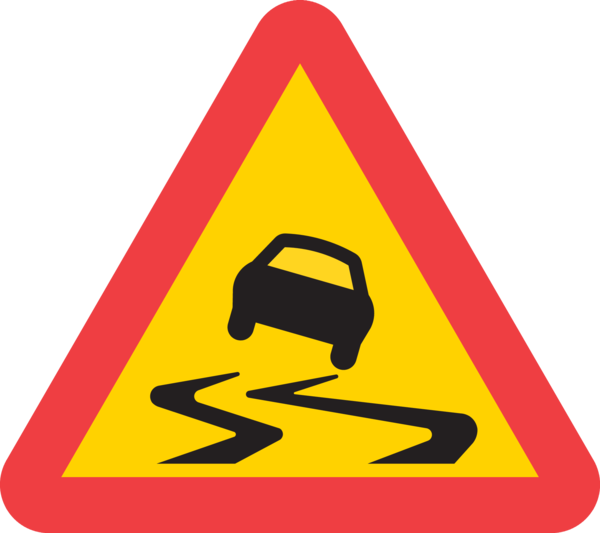
What the law says
Ett fordons hastighet skall anpassas till vad trafiksäkerheten kräver. Hänsyn skall tas till väg-, terräng-, väderleks- och siktförhållandena, fordonets skick och belastning samt trafikförhållandena i övrigt.Unofficial translation: The speed of a vehicle is adapted to what road safety requires. Account is taken of road, terrain, weather and visibility conditions, the condition and load of the vehicle, and other traffic conditions.
3 kap. 14 § trafikförordningen
Try it yourself
2 questions from this lesson, no sign-in.
On a slippery bend you have to both brake and turn. How does the tyre share these two tasks?
The two tasks use the same contact area; there is no separate budget.
The two can overlap; the driver may try to brake and turn at the same time.
The grip a tyre can provide is limited, and braking, accelerating and changing direction share this single budget. Turning the steering wheel while braking hard uses up the share left for turning, and the car carries on straight ahead. On a slippery bend the correct sequence is to brake before the bend and devote all the grip to turning in the bend.
It is below freezing and you want to test your brakes to feel how slippery it is. Where do you do it?
Grit gives better grip than the road, so the test tells you little.
The driver behind is not expecting you to brake and may hit you.
Test your brakes on the road you are going to drive on, so that you feel how much grip it has, and do it where you will not hinder or endanger anyone (3 kap. 16 § and 2 kap. 1 § trafikförordningen). A driver behind you is not expecting you to brake and may run into you.
More questions on this topic are in the app.