
Overtaking · 2/3
Overtaking safely
2 min read
You begin overtaking only if the lane is free for a sufficiently long distance and you will be able to move back to the right without danger at the end.
Before you start
- The lane you will use must be free of oncoming traffic and obstacles throughout the whole manoeuvre. The gap at that moment is not enough.
- If you cannot see this, you do not start. If a hill crest blocks your view, you stay in your lane and wait for the view to open. Pulling out into the opposite lane to look is not a safe way to check.
- After overtaking, you must be able to move back to the right without endangering anyone. Starting the manoeuvre does not remove this condition. When overtaking in a lane closed to oncoming traffic, this condition is not required.
- The vehicle ahead being slow does not remove these conditions.
If a vehicle is coming towards you, the distance shrinks quickly, because the speeds of the two vehicles add up. If the vehicle ahead is a long lorry, your passing distance is longer too. The right thing is to wait behind it. Passing on the right is not a permitted solution either.
If a vehicle appears oncoming after you have started
If you are still behind the vehicle ahead and there is a safe gap to move back into your own lane, you reduce your speed and abandon the overtaking. You do not speed up and pull alongside the vehicle ahead, and you do not wait at the same speed in the oncoming lane. This is right for exactly this situation: there is no single emergency recipe for different positions.
When moving back to the right
You move back when there is a gap you can move into without danger or obstruction. The overtaken vehicle being fully visible in the interior mirror is a practical hint; it does not guarantee enough distance. If that driver would have to brake, and you can stay safely in the oncoming lane, you wait until there is a gap. Signalling does not hand the responsibility for braking to the driver behind.
If you are being overtaken
- Every driver who notices they are about to be overtaken keeps as far to the right as possible, does not increase speed, and does not make the overtaking harder in any other way.
- If you are driving at normal speed, you do not need to slow down noticeably.
- If your vehicle is slow or takes up a lot of room, and the road is narrow, winding or has little oncoming traffic, you reduce your speed and, if necessary, pull over at the first opportunity.
- Staying below the speed limit does not excuse you from this. Driving extremely slowly without a valid reason and holding others up is also prohibited.
What the law says
Omkörning får ske endast om det körfält som skall användas vid omkörningen på en tillräckligt lång sträcka är fritt från mötande trafik eller annat hinder mot omkörning.Unofficial translation: Overtaking may take place only if the lane to be used in the overtaking is, for a sufficiently long distance, free from oncoming traffic or other obstruction to overtaking.
3 kap. 36 § trafikförordningen
Try it yourself
2 questions from this lesson, no sign-in.
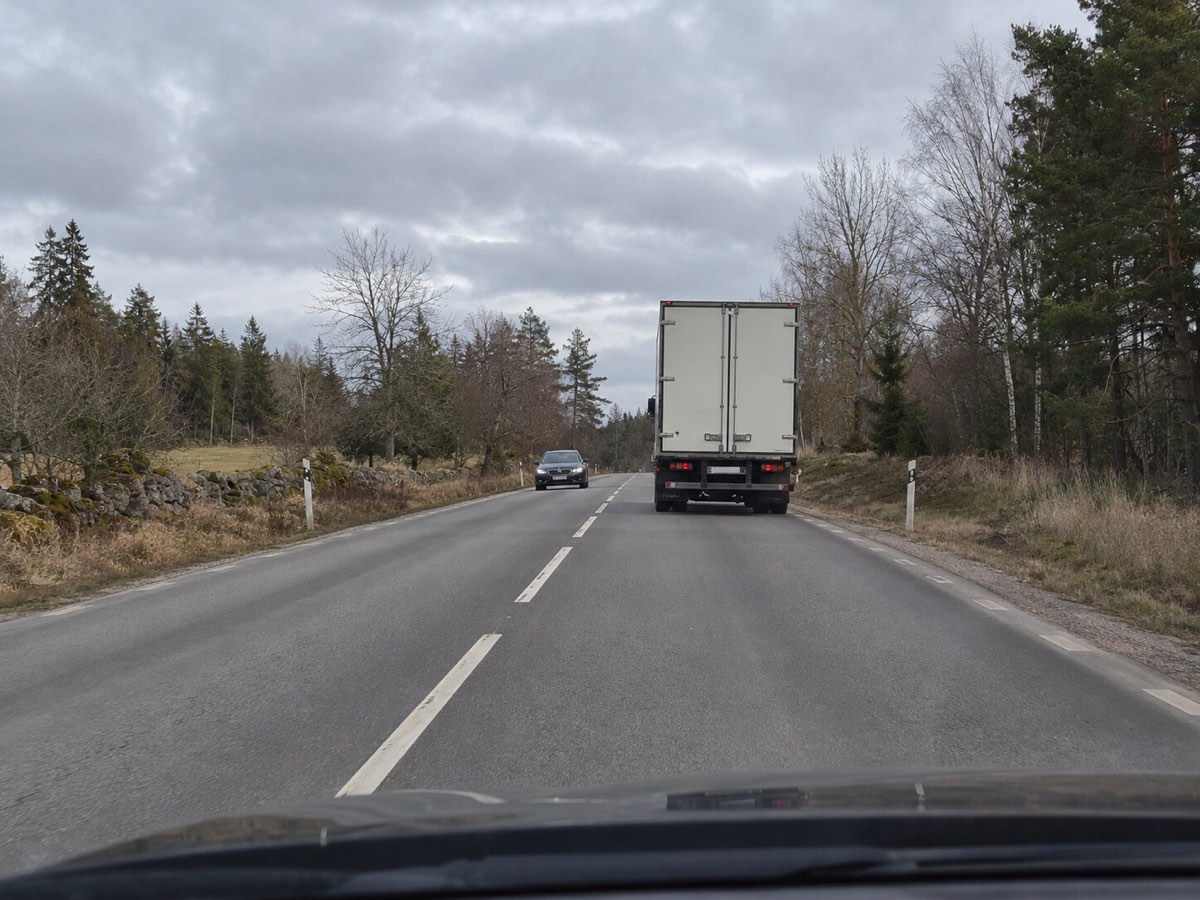
You want to overtake the lorry in the photo. What is the best thing to do?
Close behind the lorry you cannot see past it and risk hitting it.
First you must see that the lane is clear far enough ahead.
A car is coming towards you, so the oncoming lane is not clear for a long enough distance and you must not overtake now (3 kap. 36 § trafikförordningen). Stay far enough back to see past the lorry, and only overtake once you can see that the lane is clear far enough ahead.
You have just overtaken a lorry on the motorway. There is another lorry a little way ahead that you are also going to overtake. Nobody is behind you. What applies?
The law makes an exception when you will shortly overtake another vehicle.
Keeping to the speed limit gives no right to stay in the left lane.
Under 3 kap. 37 § trafikförordningen you must move back to the right as soon as it is safe after overtaking. If the road has at least two lanes in your direction, you may stay in the left lane if you will shortly overtake again and traffic behind is not noticeably held up.
More questions on this topic are in the app.