
Checks and maintenance · 2/6
Checking the lights
2 min read
The indicator on the panel does not prove the outside lights work. You check the headlights, brake lights, rear lights and indicators separately.
The front headlights working does not show the rear lights work. You do the check with the car stationary and safe, and get help if needed. You do not leave the car able to move just to check on your own.
Brake light
Brake lights are mandatory equipment, and both must work. With one out, the driver behind notices too late that you are slowing down. You replace a faulty bulb as soon as possible and do not leave it for the next service. When you are alone, it is enough to approach a wall and look at the reflection.
Dirty headlights
Dirty or wrongly aimed headlights make seeing in the dark noticeably harder. The lamp being lit does not show that the dirt has no effect. Before setting off you clean the glass and check the lighting. Higher speed does not cancel out the effect of the dirt.
Load and headlight height
A load can change the vertical direction of the light and dazzle oncoming drivers. If the headlight height is adjusted by hand, you set it for the load as the handbook says. The aim is not to put the headlights as high as possible. Choosing dipped lights does not replace this adjustment. Some headlights level automatically; they have no such adjustment.
Dipped beam pattern on a wall
If dipped headlights () set for right-hand traffic are held against a wall, then seen from behind the car the edge of the light is low on the left and high on the right. The aim is to light the right side more while limiting the light going into the oncoming lane. This pattern does not prove there will never be dazzle. Correct aim and the load still matter.
A single red light in the dark
Seeing one light does not prove the vehicle is narrow or a motorcycle. The other light may be faulty or not visible. You set your speed and gap by the real visibility, the traffic situation and being able to stop safely.
What the law says
Lyktor och strålkastare får inte användas på sådant sätt att andra förare kan bländas.Unofficial translation: Lamps and headlights may not be used in such a way that other drivers can be dazzled.
3 kap. 67 § trafikförordningen
Try it yourself
2 questions from this lesson, no sign-in.
You have loaded the boot heavily but not adjusted the headlight levelling. How are your dipped headlights affected?
The load lowers the rear, so the front and the beam tilt up.
Dipped headlights tilt with the car when it is loaded.
A heavy load in the boot pushes the rear down, so the front of the car and the headlights point upwards. Lower the beam with the levelling control as the manual says, because you must not dazzle other drivers (3 kap. 67 § trafikförordningen).
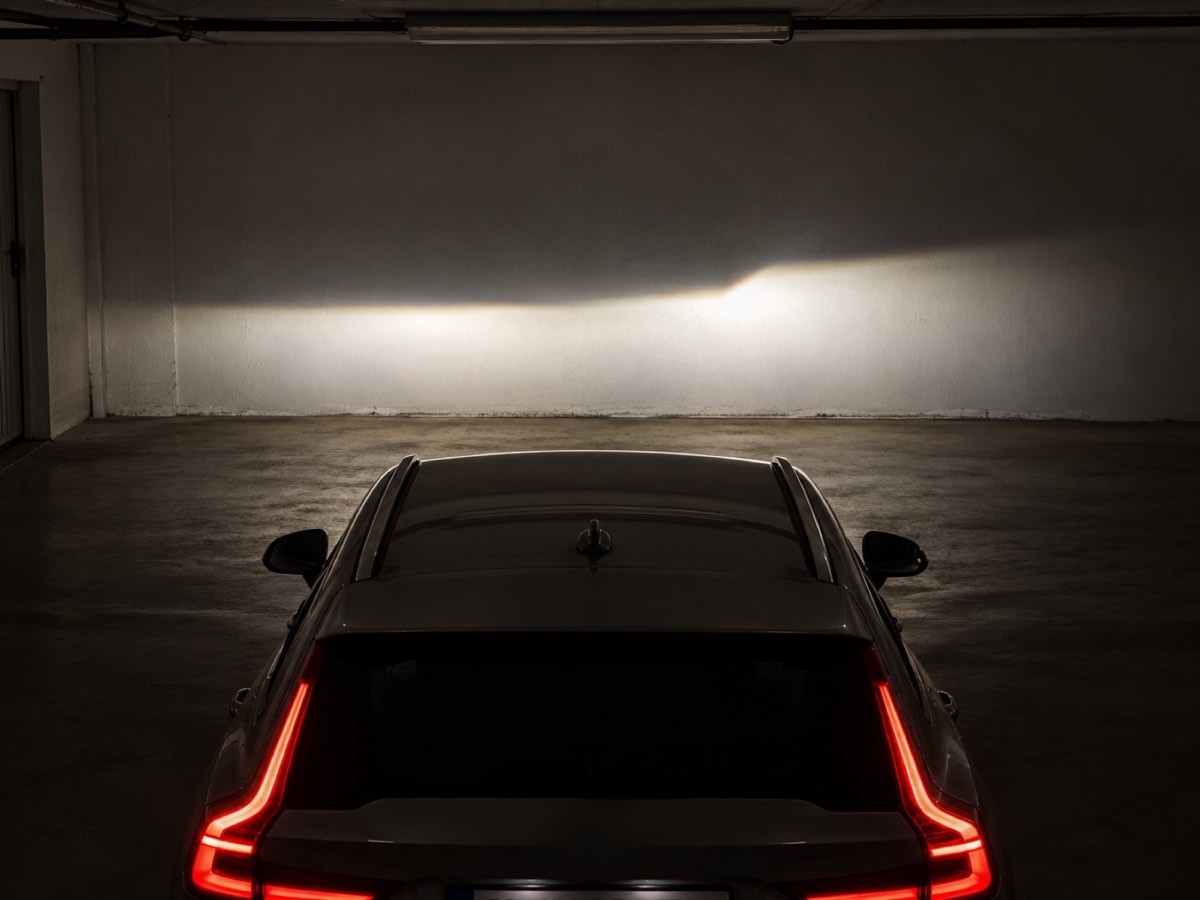
The car is facing a wall with its dipped headlights on. What does the light pattern on the wall show?
For left-hand traffic the cut-off would rise to the left.
The sloping cut-off is deliberate, not an aiming fault.
The photo is taken from behind, so the right of the picture is the car's right. The cut-off rises to the right, so the dipped beam reaches further along the right-hand verge and stays lower towards oncoming traffic, as it should in right-hand traffic.
More questions on this topic are in the app.