
Adapting your speed
2 min read
The number on a sign is a maximum, not a target. You choose your speed to suit the conditions: you must be able to stop on the stretch of road you can see and in front of any obstacle you can foresee.
What do you take into account?
The road, the terrain, the weather and visibility, the condition and load of your vehicle, and the traffic conditions. This list applies to all vehicles and does not depend on there being a warning sign.
If visibility is limited
The measure is the distance you can see. If you can see 50 metres in fog, you slow down to a speed at which you can stop within 50 metres. No separate sign is needed for fog. Light traffic or fog lights do not change this. The same measure applies when it is snowing: if necessary, you drive slower than the flow of traffic. The speed of the vehicles ahead is not the measure.
Examples of places that call for a low enough speed
- At pedestrian crossings and where pedestrians cross the road.
- When approaching a bus, a tram or a school bus that has stopped to let passengers off or on.
- When there are children on the road or beside it.
A child may step into the road unexpectedly. You reduce your speed in advance and are ready to stop. You do not wait until you are level with the bus. Traffic behind you is no justification, and staying within the limit is not enough.
If a bus hides the area in front of it, you do not assume that area is empty. Seeing people on the pavement does not prove it.
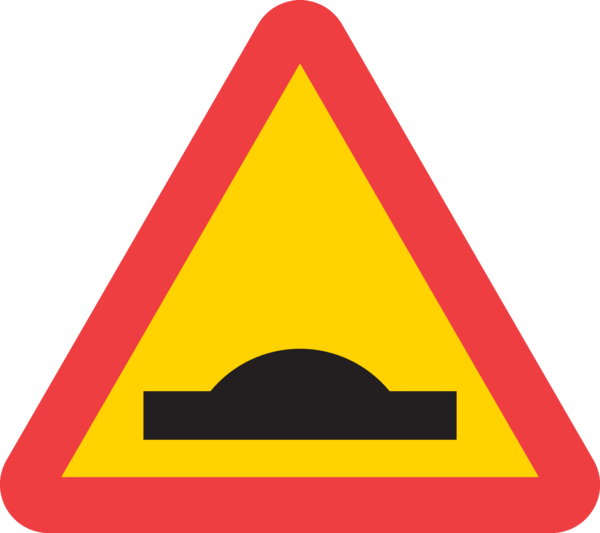
Speed bump
Driving too slowly
Driving below the limit is not a fault in itself. It is right if conditions require it. But you must not hold others up by driving extremely slowly without a valid reason. Driving at 50 on a 90 road in good conditions is a problem if it holds up traffic for no reason. Slowness does not create safety in itself.
What the law says
Ett fordons hastighet skall anpassas till vad trafiksäkerheten kräver. Hänsyn skall tas till väg-, terräng-, väderleks- och siktförhållandena, fordonets skick och belastning samt trafikförhållandena i övrigt.Unofficial translation: The speed of a vehicle shall be adapted to what road safety requires. Account shall be taken of the road, terrain, weather and visibility conditions, the condition and load of the vehicle and the traffic conditions in general.
3 kap. 14 § trafikförordningen
Try it yourself
2 questions from this lesson, no sign-in.
You are driving at 70 km/h on a country road. A bus has stopped at a bus stop and passengers are getting off. Which is correct?
The rule asks for a low speed, not for you to stop and wait.
The signal rule is for roads limited to 50 km/h; you must still slow down here.
Under 3 kap. 15 § trafikförordningen you must keep a sufficiently low speed when approaching a bus, tram or school bus that has stopped to let passengers on or off. You do not have to stop, but someone may step out in front of the bus, so slow down early.
It is snowing, the road is white, the limit is 80 and the cars ahead are doing 60. What decides your speed?
Driving excessively slowly without good reason holds other drivers up.
The flow is not a measure of safe speed; speed is chosen by conditions and visibility.
The posted limit is an upper limit; speed must also suit the road and weather.
Speed is adapted to road, weather and visibility. The driver must keep control and be able to stop within the distance they can see ahead (Traffic Ordinance, chapter 3, section 14). Neither the posted limit nor the speed of the flow replaces that requirement. At the same time, you must not drive excessively slowly without good reason and hold others up (chapter 3, section 16).
More questions on this topic are in the app.